
Seeing lots of explainers about the reddit/hedge fund drama right now, and as someone who worked as a quant for a big fund for 7 years, figured I'd chime in. This whole situation is pretty much why I quit. Big thread.
More from For later read


Excited we finally have a draft of this paper, which attempts to provide a 'unifying theory' of the long economic divergence between the Middle East & Western Europe
As we see it, there are 3 recent theories that hit on important aspects of the divergence...
1/
One set of theories focus on the legitimating power of Islam (Rubin, @prof_ahmetkuru, Platteau). This gave religious clerics greater power, which pulled political resources away form those encouraging economic development
But these theories leave some questions unanswered...
2/
Religious legitimacy is only effective if people
care what religious authorities dictate. Given the economic consequences, why do people remain religious, and thereby render religious legitimacy effective? Is religiosity a cause or a consequence of institutional arrangements?
3/
Another set of theories focus on the religious proscriptions of Islam, particular those associated with Islamic law (@timurkuran). These laws were appropriate for the setting they formed but had unforeseeable consequences and failed to change as economic circumstances changed
4/
There are unaddressed questions here, too
Muslim rulers must have understood that Islamic law carried proscriptions that hampered economic development. Why, then, did they continue to use Islamic institutions (like courts) that promoted inefficiencies?
5/
As we see it, there are 3 recent theories that hit on important aspects of the divergence...
1/
New CEPR Discussion Paper - DP15802
— CEPR (@cepr_org) February 14, 2021
Culture, Institutions & the Long Divergence@albertobisin @nyuniversity, Jared Rubin @jaredcrubin @ChapmanU, Avner Seror @SerorAvner @amseaixmars @univamu, Thierry Verdier @PSEinfohttps://t.co/lhs6AJb7jE#CEPR_DE, #CEPR_EH, #CEPR_ITRE pic.twitter.com/FtMzAELljJ
One set of theories focus on the legitimating power of Islam (Rubin, @prof_ahmetkuru, Platteau). This gave religious clerics greater power, which pulled political resources away form those encouraging economic development
But these theories leave some questions unanswered...
2/
Religious legitimacy is only effective if people
care what religious authorities dictate. Given the economic consequences, why do people remain religious, and thereby render religious legitimacy effective? Is religiosity a cause or a consequence of institutional arrangements?
3/
Another set of theories focus on the religious proscriptions of Islam, particular those associated with Islamic law (@timurkuran). These laws were appropriate for the setting they formed but had unforeseeable consequences and failed to change as economic circumstances changed
4/
There are unaddressed questions here, too
Muslim rulers must have understood that Islamic law carried proscriptions that hampered economic development. Why, then, did they continue to use Islamic institutions (like courts) that promoted inefficiencies?
5/

You May Also Like


Fake chats claiming to be from the Irish African community are being disseminated by the far right in order to suggest that violence is imminent from #BLM supporters. This is straight out of the QAnon and Proud Boys playbook. Spread the word. Protest safely. #georgenkencho

There is co-ordination across the far right in Ireland now to stir both left and right in the hopes of creating a race war. Think critically! Fascists see the tragic killing of #georgenkencho, the grief of his community and pending investigation as a flashpoint for action.
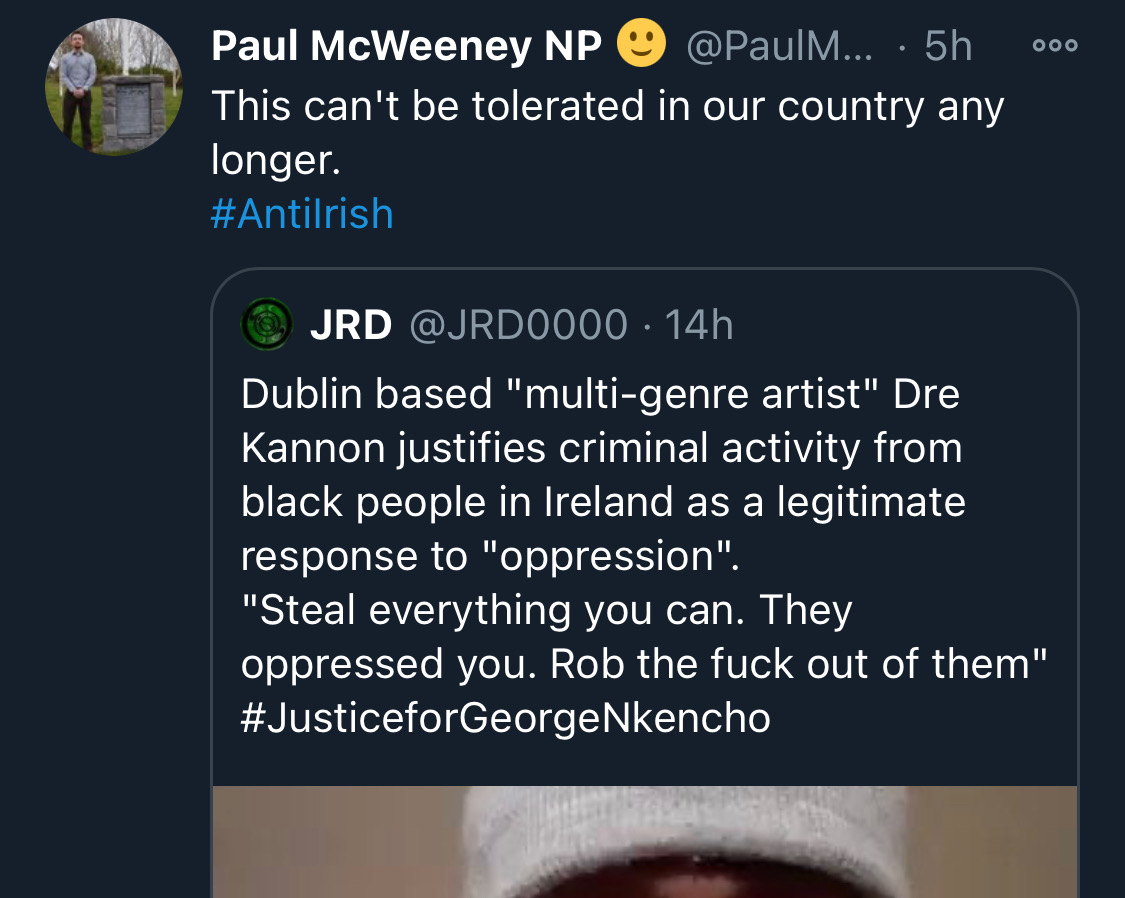
Across Telegram, Twitter and Facebook disinformation is being peddled on the back of these tragic events. From false photographs to the tactics ofwhite supremacy, the far right is clumsily trying to drive hate against minority groups and figureheads.
Declan Ganley’s Burkean group and the incel wing of National Party (Gearóid Murphy, Mick O’Keeffe & Co.) as well as all the usuals are concerted in their efforts to demonstrate their white supremacist cred. The quiet parts are today being said out loud.
The best thing you can do is challenge disinformation and report posts where engagement isn’t appropriate. Many of these are blatantly racist posts designed to drive recruitment to NP and other Nationalist groups. By all means protest but stay safe.
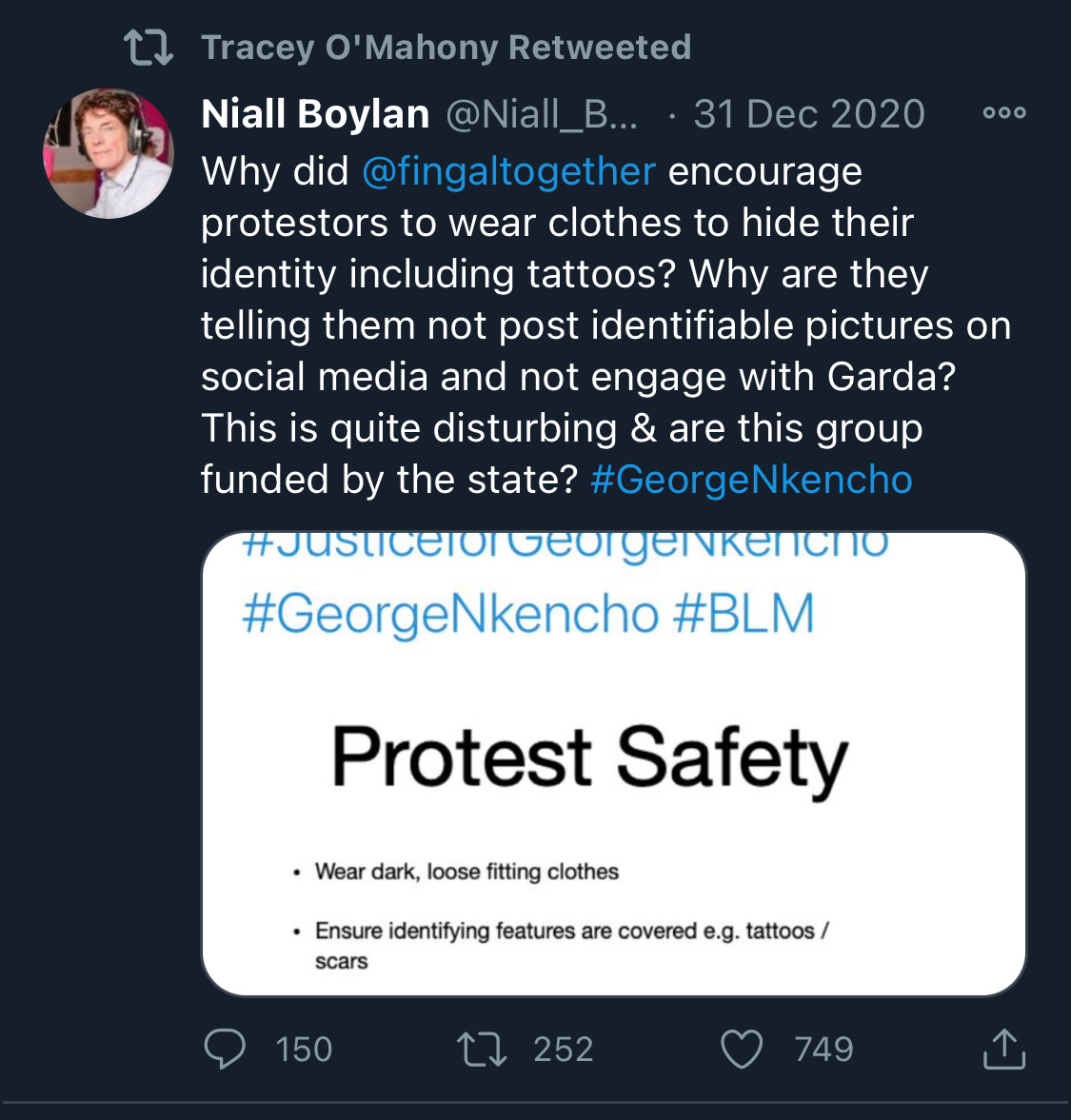
There is co-ordination across the far right in Ireland now to stir both left and right in the hopes of creating a race war. Think critically! Fascists see the tragic killing of #georgenkencho, the grief of his community and pending investigation as a flashpoint for action.
Across Telegram, Twitter and Facebook disinformation is being peddled on the back of these tragic events. From false photographs to the tactics ofwhite supremacy, the far right is clumsily trying to drive hate against minority groups and figureheads.
Be aware, the images the #farright are sharing in the hopes of starting a race war, are not of the SPAR employee that was punched. They\u2019re older photos of a Everton fan. Be aware of the information you\u2019re sharing and that it may be false. Always #factcheck #GeorgeNkencho pic.twitter.com/4c9w4CMk5h
— antifa.drone (@antifa_drone) December 31, 2020
Declan Ganley’s Burkean group and the incel wing of National Party (Gearóid Murphy, Mick O’Keeffe & Co.) as well as all the usuals are concerted in their efforts to demonstrate their white supremacist cred. The quiet parts are today being said out loud.
There is a concerted effort in far-right Telegram groups to try and incite violence on street by targetting people for racist online abuse following the killing of George Nkencho
— Mark Malone (@soundmigration) January 1, 2021
This follows on and is part of a misinformation campaign to polarise communities at this time.
The best thing you can do is challenge disinformation and report posts where engagement isn’t appropriate. Many of these are blatantly racist posts designed to drive recruitment to NP and other Nationalist groups. By all means protest but stay safe.




First update to https://t.co/lDdqjtKTZL since the challenge ended – Medium links!! Go add your Medium profile now 👀📝 (thanks @diannamallen for the suggestion 😁)

Just added Telegram links to https://t.co/lDdqjtKTZL too! Now you can provide a nice easy way for people to message you :)

Less than 1 hour since I started adding stuff to https://t.co/lDdqjtKTZL again, and profile pages are now responsive!!! 🥳 Check it out -> https://t.co/fVkEL4fu0L

Accounts page is now also responsive!! 📱✨

💪 I managed to make the whole site responsive in about an hour. On my roadmap I had it down as 4-5 hours!!! 🤘🤠🤘
Just added Telegram links to https://t.co/lDdqjtKTZL too! Now you can provide a nice easy way for people to message you :)
Less than 1 hour since I started adding stuff to https://t.co/lDdqjtKTZL again, and profile pages are now responsive!!! 🥳 Check it out -> https://t.co/fVkEL4fu0L
Accounts page is now also responsive!! 📱✨
💪 I managed to make the whole site responsive in about an hour. On my roadmap I had it down as 4-5 hours!!! 🤘🤠🤘