Yup, autocorrect. 😅
More from Sahil Sharma
Given the immense interest in this #investment #process thread about how to get investment ideas, thought of creating a logical follow-up 🧵
Given that I have an idea & some sense for valuation & growth, how do i construct a portfolio?
If you like the thread, plz RT.
First thing worth mentioning is that I am only describing my own process. Others can follow a different process which could work for them.
Opposite of a good idea can also be a good idea
Before understanding the process itself, it is important to understand the problems the process is being designed to solve for. What are the key hurdles or troubles I have faced in designing my PF.
Hurdles
1. At any given point in time (in the past) i have only known deeply about 5% of the listed universe in India, or lower. When I say know deeply I mean read an annual report, an investor presentation, a concall, understood why the business is how it is.
2. I only started my corporate life 4 years ago, so my pf size is small compared to yearly savings. This means that I need to deploy large incremental capital every year at least for next few years. This cant be a buy & track pf, this is a keep buying & tracking for a few yrs pf
Given that I have an idea & some sense for valuation & growth, how do i construct a portfolio?
If you like the thread, plz RT.
A lot of people ask: how do you find companies to invest in? very good question.
— Sahil Sharma (@sahil_vi) July 6, 2021
How did you find RACL, Pix?
Creating this ad-hoc thread to share my process.
if you like it, please RT to benefit maximum investors. \U0001f64f
First thing worth mentioning is that I am only describing my own process. Others can follow a different process which could work for them.
Opposite of a good idea can also be a good idea
Before understanding the process itself, it is important to understand the problems the process is being designed to solve for. What are the key hurdles or troubles I have faced in designing my PF.
Hurdles
1. At any given point in time (in the past) i have only known deeply about 5% of the listed universe in India, or lower. When I say know deeply I mean read an annual report, an investor presentation, a concall, understood why the business is how it is.
2. I only started my corporate life 4 years ago, so my pf size is small compared to yearly savings. This means that I need to deploy large incremental capital every year at least for next few years. This cant be a buy & track pf, this is a keep buying & tracking for a few yrs pf
#neulandlab 🌋🌋 read on to understand this company and its story of transformation. On twitter, 🌋 has become synonymous with neuland, and this is how i will use it throughout the thread. If you like the thread, plz retweet & help fellow investors learn

Starting with a simple primer on the Pharma industry. They make medicines for all of us. The part of the medicine which gives it its potency against the ailment it cures is called API: Active Pharmaceutical
(here is a reference few people will get, but have to make it since I love it :D):
If Guardians of the globe (https://t.co/vH2C1TDbPy) were a medicine, Omniman (https://t.co/0DGb1MAtXN) is the API.
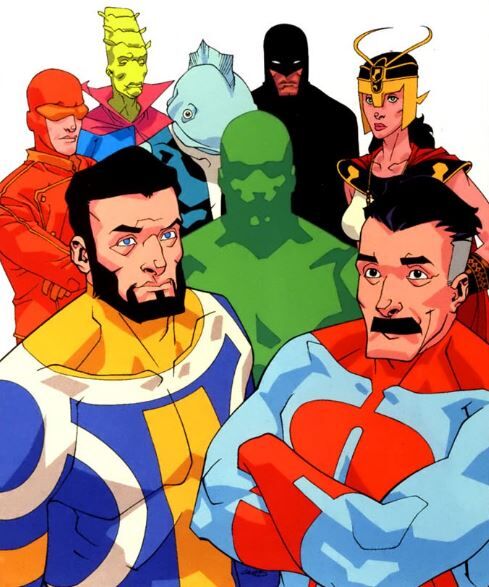
Back to 🌋. There are pharma companies which sell APIs as well as the finished medicine (FDF: Finished Dosage Formulation). Neuland are pureplay API manufacturers. This provides them some advantage since they don't compete with their clients (the FDF makers).
Medicine is diverse. There are medicine which were first discovered in 1920s (https://t.co/6DXNrhOK46), to those being created now (https://t.co/tcr7dAexmO). Naturally then, some of this involves very complex chemistry to manufacture, others are relatively easier to manufacture.
Starting with a simple primer on the Pharma industry. They make medicines for all of us. The part of the medicine which gives it its potency against the ailment it cures is called API: Active Pharmaceutical
(here is a reference few people will get, but have to make it since I love it :D):
If Guardians of the globe (https://t.co/vH2C1TDbPy) were a medicine, Omniman (https://t.co/0DGb1MAtXN) is the API.
Back to 🌋. There are pharma companies which sell APIs as well as the finished medicine (FDF: Finished Dosage Formulation). Neuland are pureplay API manufacturers. This provides them some advantage since they don't compete with their clients (the FDF makers).
Medicine is diverse. There are medicine which were first discovered in 1920s (https://t.co/6DXNrhOK46), to those being created now (https://t.co/tcr7dAexmO). Naturally then, some of this involves very complex chemistry to manufacture, others are relatively easier to manufacture.
This thread is to create awareness on how to use
https://t.co/3jeqlXO0QH
Please note that i am not officially associated with website. Only an active contributor & hope to benefit from network effects of interested investors actively contributing on platform.
https://t.co/64yVScplqi is above all else a community of like minded investors who wants to actively engage in understandin at a fundamental level & separate wheat from the chaff.
Develop an understanding of the biz, industry, competitive intensity, management, valuation
Website was created > 10 years ago. Early users are seasoned investors & i personally look to learn greatly by following their footprints across the website.
There are broadly speaking 4-5 types of "threads" or discussion places across the website.
1. Featured discussions (hall of fame, showcase discussions, learning).
These enable investor to level up the most. These discussions are a showcase for the website itself.
These are also a great starting point. Since VP is not a course, feel free to traverse them in any order
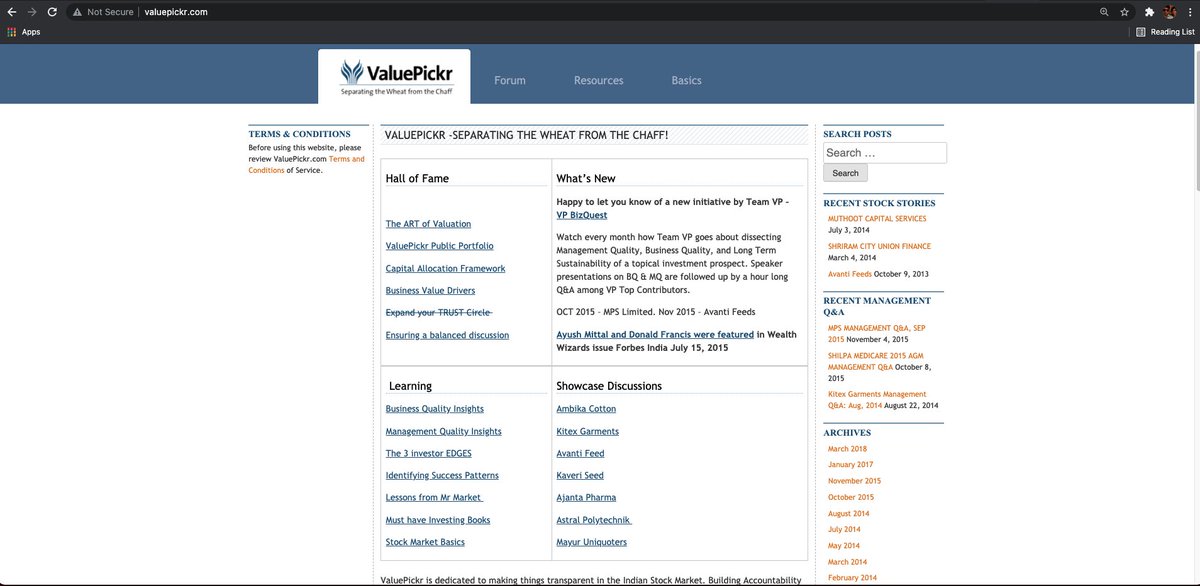
https://t.co/3jeqlXO0QH
Please note that i am not officially associated with website. Only an active contributor & hope to benefit from network effects of interested investors actively contributing on platform.
https://t.co/64yVScplqi is above all else a community of like minded investors who wants to actively engage in understandin at a fundamental level & separate wheat from the chaff.
Develop an understanding of the biz, industry, competitive intensity, management, valuation
Website was created > 10 years ago. Early users are seasoned investors & i personally look to learn greatly by following their footprints across the website.
There are broadly speaking 4-5 types of "threads" or discussion places across the website.
1. Featured discussions (hall of fame, showcase discussions, learning).
These enable investor to level up the most. These discussions are a showcase for the website itself.
These are also a great starting point. Since VP is not a course, feel free to traverse them in any order
More from Ds


1/
Get a cup of coffee.
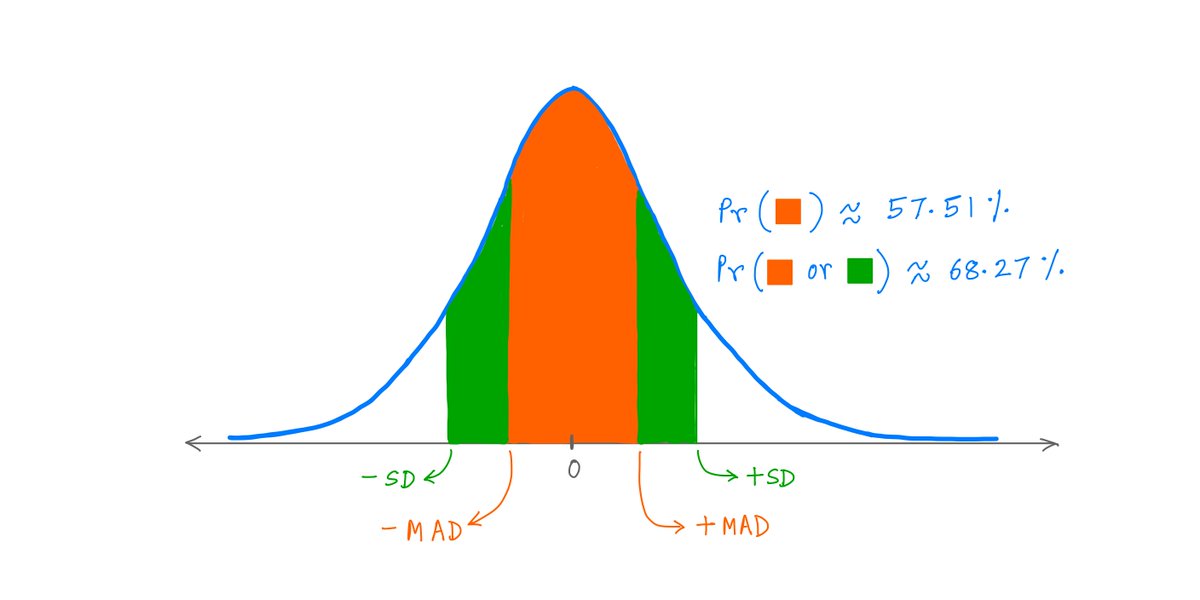
In this thread, I'll walk you through 2 probability concepts: Standard Deviation (SD) and Mean Absolute Deviation (MAD).
This will give you insight into Fat Tails -- which are super useful in investing and in many other fields.
2/
Recently, I watched 2 probability "mini-lectures" on YouTube by Nassim Taleb.
One ~10 min lecture covered SD and MAD. The other ~6 min lecture covered Fat Tails.
In these ~16 mins, @nntaleb shared so many useful nuggets that I had to write this thread to unpack them.
3/
For those curious, here are the YouTube links to the lectures:
SD and MAD (~10 min): https://t.co/0TwubymdE6
Fat Tails (~6 min):
4/
The first thing to understand is the concept of a Random Variable.
In essence, a Random Variable is a number that depends on a random event.
For example, when we roll a die, we get a Random Variable -- a number from the set {1, 2, 3, 4, 5, 6}.
5/
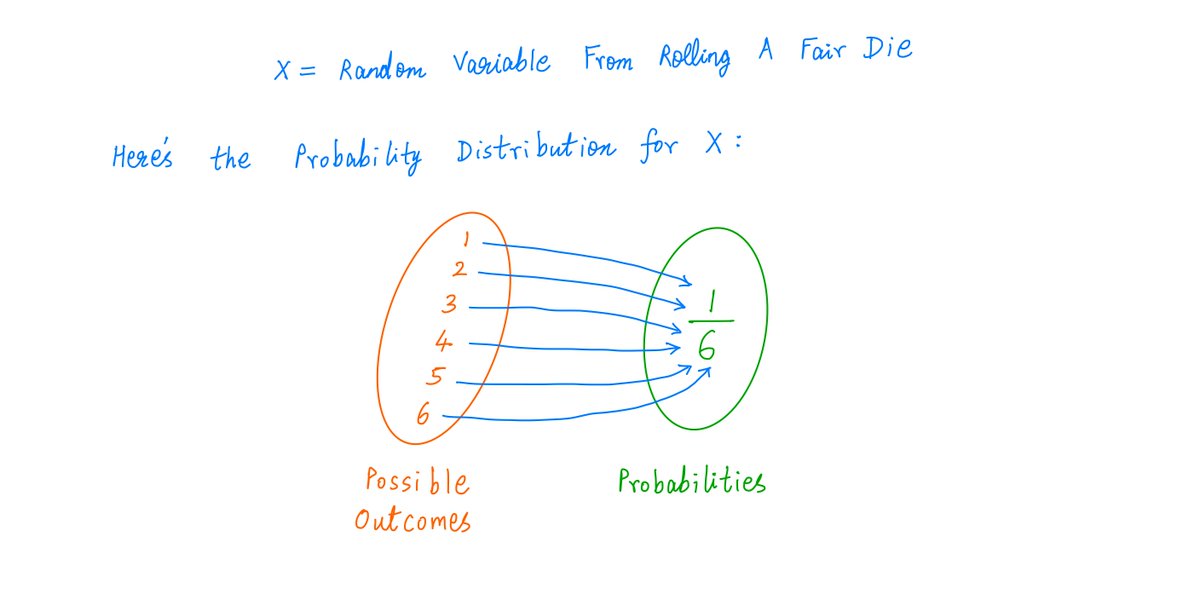
Every Random Variable has a Probability Distribution.
This tells us all the possible values the Random Variable can take, and their respective probabilities.
For example, when we roll a fair die, we get a Random Variable with this Probability Distribution:
Get a cup of coffee.
In this thread, I'll walk you through 2 probability concepts: Standard Deviation (SD) and Mean Absolute Deviation (MAD).
This will give you insight into Fat Tails -- which are super useful in investing and in many other fields.
2/
Recently, I watched 2 probability "mini-lectures" on YouTube by Nassim Taleb.
One ~10 min lecture covered SD and MAD. The other ~6 min lecture covered Fat Tails.
In these ~16 mins, @nntaleb shared so many useful nuggets that I had to write this thread to unpack them.
3/
For those curious, here are the YouTube links to the lectures:
SD and MAD (~10 min): https://t.co/0TwubymdE6
Fat Tails (~6 min):
4/
The first thing to understand is the concept of a Random Variable.
In essence, a Random Variable is a number that depends on a random event.
For example, when we roll a die, we get a Random Variable -- a number from the set {1, 2, 3, 4, 5, 6}.
5/
Every Random Variable has a Probability Distribution.
This tells us all the possible values the Random Variable can take, and their respective probabilities.
For example, when we roll a fair die, we get a Random Variable with this Probability Distribution: