Let's understand FII and DII flows (or institutional flows) in India with data. A short thread🧵.

1/n

2/n

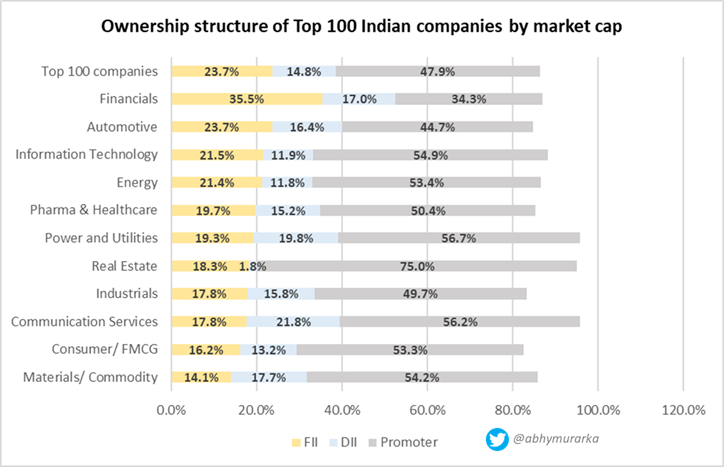
Market cap of listed universe: ~INR 180 TN (lakh crore)
Top 100 companies by market cap: 146 TN (~80%)
Ownership for Top 100 (FII/DII/ Prom): 24%/15%/48%
Highest FII share: Banking & Financials (36%)
Lowest FII share: Materials & commodities (14%)

Sector wise ownership 👇
3/n

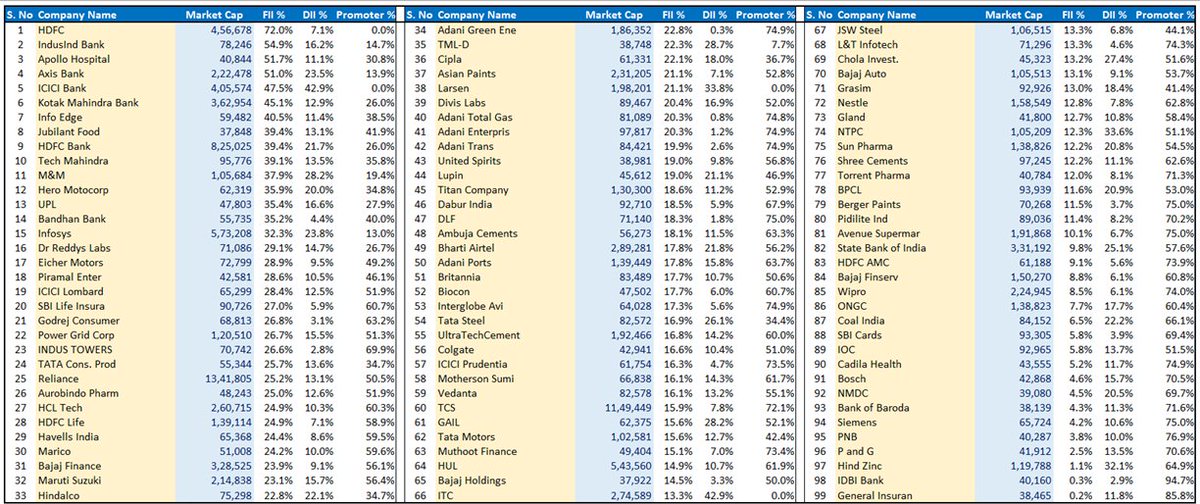
Ownership structure of Top 100 companies at December 2020 is shared below (sorted in descending order of FII). Notice that companies with high FII holding are more susceptible to direction of FII flows.

List sorted by market cap here: https://t.co/wVUgGOMMEn
4/n

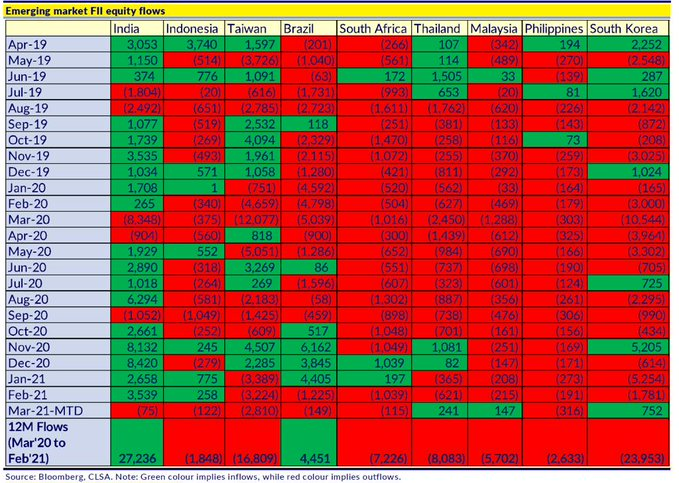
Over last 2 years and especially post the March 20 crash, India has been the cynosure of FIIs emerging market play. We are seeing the first sign of break now in March given macro cues.

Note: March data till 14th (Source: CLSA)
5/n

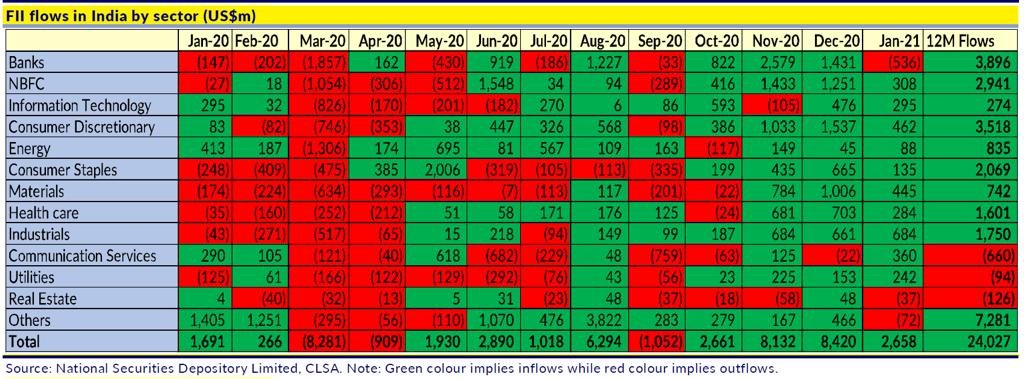
Here is how the FII flows in India stack up across sectors. Largest flows in Banks followed by Consumer discretionary. (Source: CLSA)
6/n
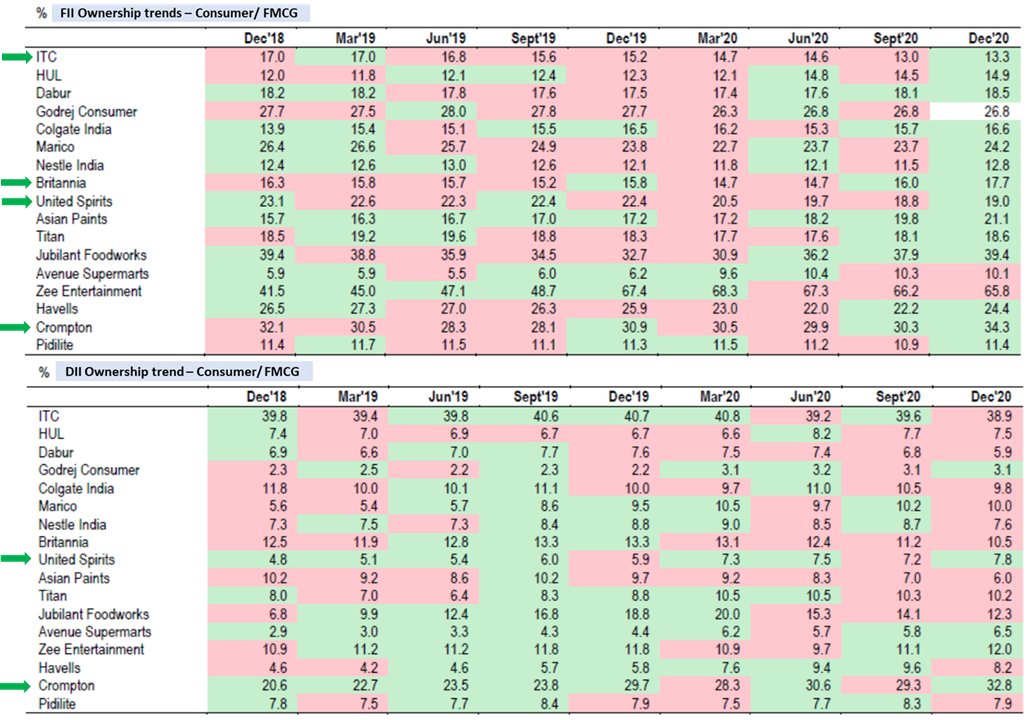
Let me take your attention back to Tweet 2. Consumer & FMCG had the second lowest FII allocation. There are signs of change there.

Check FII holding across key FMCG/ Consumer companies over 2 years. See that change in Dec quarter? Marked out few names. One for the ITC bulls.
7/n

So who are these FIIs?

Large FIIs are mainly Sovereign Wealth funds, ETFs with total global assets in trillions of dollars. Emerging markets are approx. 10% allocation. Thus a small allocation change for India means huge inflows in $ terms.

List of largest FIIs in India👇
8/n

Trivia: LIC, the largest DII, holds market value of INR 7.46 lakh crores (~4.2% of overall market cap of India). Equivalent of holdings of Top 5 FIIs in India.

Working on some data on small and midcap holdings of FIIs and increases therein. More on that later.

/End
Now this has taken some time and effort over the weekend. Show some love and RT if this helped.
Also, happy to take any questions around this topic of FII/ DII. Think I understand a bit after this exercise. Shoot.

You May Also Like

1/ Some initial thoughts on personal moats:

Like company moats, your personal moat should be a competitive advantage that is not only durable—it should also compound over time.

Characteristics of a personal moat below:


2/ Like a company moat, you want to build career capital while you sleep.

As Andrew Chen noted:


3/ You don’t want to build a competitive advantage that is fleeting or that will get commoditized

Things that might get commoditized over time (some longer than


4/ Before the arrival of recorded music, what used to be scarce was the actual music itself — required an in-person artist.

After recorded music, the music itself became abundant and what became scarce was curation, distribution, and self space.

5/ Similarly, in careers, what used to be (more) scarce were things like ideas, money, and exclusive relationships.

In the internet economy, what has become scarce are things like specific knowledge, rare & valuable skills, and great reputations.