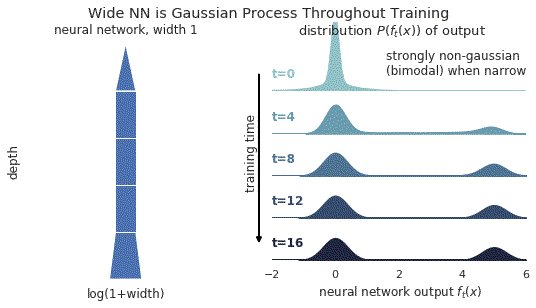
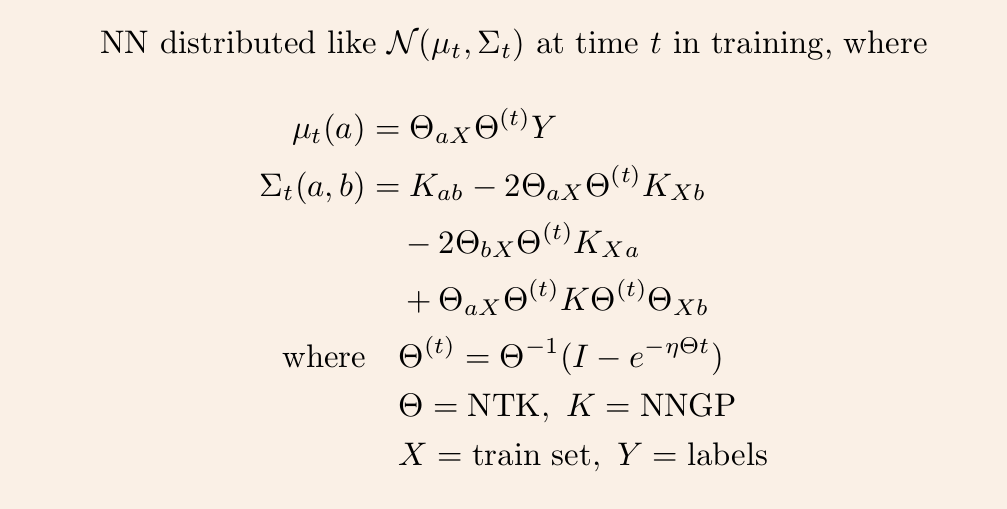
1/ A ∞-wide NN of *any architecture* is a Gaussian process (GP) at init. The NN in fact evolves linearly in function space under SGD, so is a GP at *any time* during training. https://t.co/v1b6kndqCk With Tensor Programs, we can calculate this time-evolving GP w/o trainin any NN
https://t.co/6RO7VZDQNZ
https://t.co/OOoOMdPOsR
More from Data science

I have always emphasized on the importance of mathematics in machine learning.
Here is a compilation of resources (books, videos & papers) to get you going.
(Note: It's not an exhaustive list but I have carefully curated it based on my experience and observations)
📘 Mathematics for Machine Learning
by Marc Peter Deisenroth, A. Aldo Faisal, and Cheng Soon Ong
https://t.co/zSpp67kJSg
Note: this is probably the place you want to start. Start slowly and work on some examples. Pay close attention to the notation and get comfortable with it.

📘 Pattern Recognition and Machine Learning
by Christopher Bishop
Note: Prior to the book above, this is the book that I used to recommend to get familiar with math-related concepts used in machine learning. A very solid book in my view and it's heavily referenced in academia.

📘 The Elements of Statistical Learning
by Jerome H. Friedman, Robert Tibshirani, and Trevor Hastie
Mote: machine learning deals with data and in turn uncertainty which is what statistics teach. Get comfortable with topics like estimators, statistical significance,...

📘 Probability Theory: The Logic of Science
by E. T. Jaynes
Note: In machine learning, we are interested in building probabilistic models and thus you will come across concepts from probability theory like conditional probability and different probability distributions.
Here is a compilation of resources (books, videos & papers) to get you going.
(Note: It's not an exhaustive list but I have carefully curated it based on my experience and observations)
📘 Mathematics for Machine Learning
by Marc Peter Deisenroth, A. Aldo Faisal, and Cheng Soon Ong
https://t.co/zSpp67kJSg
Note: this is probably the place you want to start. Start slowly and work on some examples. Pay close attention to the notation and get comfortable with it.
📘 Pattern Recognition and Machine Learning
by Christopher Bishop
Note: Prior to the book above, this is the book that I used to recommend to get familiar with math-related concepts used in machine learning. A very solid book in my view and it's heavily referenced in academia.
📘 The Elements of Statistical Learning
by Jerome H. Friedman, Robert Tibshirani, and Trevor Hastie
Mote: machine learning deals with data and in turn uncertainty which is what statistics teach. Get comfortable with topics like estimators, statistical significance,...
📘 Probability Theory: The Logic of Science
by E. T. Jaynes
Note: In machine learning, we are interested in building probabilistic models and thus you will come across concepts from probability theory like conditional probability and different probability distributions.


To my JVM friends looking to explore Machine Learning techniques - you don’t necessarily have to learn Python to do that. There are libraries you can use from the comfort of your JVM environment. 🧵👇
https://t.co/EwwOzgfDca : Deep Learning framework in Java that supports the whole cycle: from data loading and preprocessing to building and tuning a variety deep learning networks.
https://t.co/J4qMzPAZ6u Framework for defining machine learning models, including feature generation and transformations, as directed acyclic graphs (DAGs).
https://t.co/9IgKkSxPCq a machine learning library in Java that provides multi-class classification, regression, clustering, anomaly detection and multi-label classification.
https://t.co/EAqn2YngIE : TensorFlow Java API (experimental)
https://t.co/EwwOzgfDca : Deep Learning framework in Java that supports the whole cycle: from data loading and preprocessing to building and tuning a variety deep learning networks.
https://t.co/J4qMzPAZ6u Framework for defining machine learning models, including feature generation and transformations, as directed acyclic graphs (DAGs).
https://t.co/9IgKkSxPCq a machine learning library in Java that provides multi-class classification, regression, clustering, anomaly detection and multi-label classification.
https://t.co/EAqn2YngIE : TensorFlow Java API (experimental)