What do you think folks, shall we do some bad book covers today?

I think we should...

"I have made some bad decisions in my life..."

Dressed Up For Murder, by Gary Brander. Fastback, 1986.
"It's not you Mr Darcy, it's me..."

Pride and Prejudice, by Jane Austen. Bestseller Library, 1966.
Move along Twitter, nothing to see here...

The Star Fox, by Poul Anderson. Panther Books 1968. Cover by Bob Haberfield.
Fangs For The Mammaries, edited by Esther Friesner. Baen Books 2010. Art by Clyde Caldwell.

I see what you did there Clyde...
Croak, by Robin Evans. Hamlin Books, 1981.

Reddit. Reddit...
The Hungry Ones, by Craig Douglas. Crescent, 1966.

I'm not sure about this clown...
Star Trek: The Motion Picture! Oh hang on...

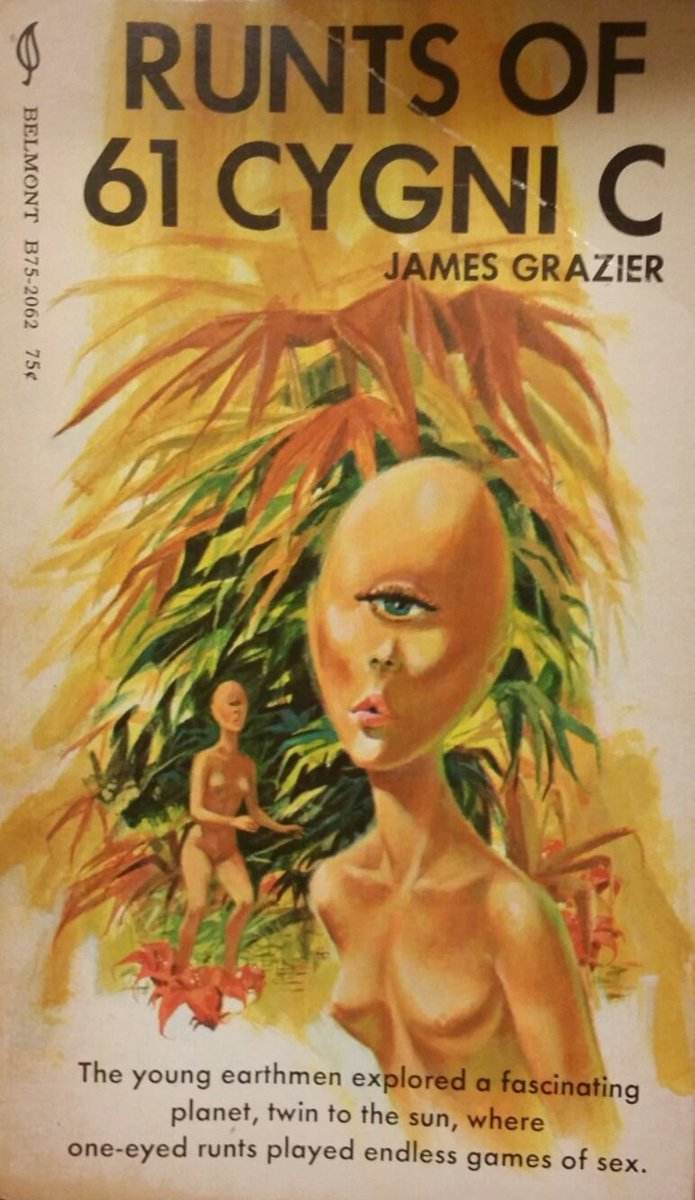
Runts of 61 Cygni C, by James Grazier. Belmont Books, 1970.
The Spy Who Loved Me, by Ian Fleming. Pan, 1971.

Where's her left leg gone?
Sparks are back on tour I see...

The Iron Dream, by Norman Spinrad. Timescale, 1982.
Don't even get me started on Asimov book covers...
Herovit's World, by Barry N Malzberg. Pocket Books, 1974.

Not my type...
"Surging womanhood!"

The Sex Life of the Gods, by Michael Knerr. Uptown Books, 1962.
The Fungus, by Harry ("the new Stephen King") Adam Knight. Star Books, 1975.

I'm lichen this cover art...
More bad book covers another time. You can't judge...

More from Pulp Librarian

More from Culture

.@bellingcat's attempt in their new book, published by
@BloomsburyBooks, to coverup the @OPCW #Douma controversy, promote US and UK gov. war narratives, and whitewash fraudulent conduct within the OPCW, is an exercise in deception through omission @marydejevsky @freddiesayers


1) 2000 words are devoted to the OPCW controversy regarding the alleged chemical weapon attack in #Douma, Syria in 2018 but critical material is omitted from the book. Reading it, one would never know the following:

2) That the controversy started when the original interim report, drafted and agreed by Douma inspection team members, was secretly modified by an unknown OPCW person who had manipulated the findings to suggest an attack had occurred. https://t.co/QtAAyH9WyX… @RobertF40396660



3) This act of attempted deception was only derailed because an inspector discovered the secret changes. The manipulations were reported by @ClarkeMicah
and can be readily observed in documents now available https://t.co/2BUNlD8ZUv….

4) .@bellingcat's book also makes no mention of the @couragefoundation panel, attended by the @opcw's first Director General, Jose Bustani, at which an OPCW official detailed key procedural irregularities and scientific flaws with the Final Douma Report:

You May Also Like

Rig Ved 1.36.7

To do a Namaskaar or bow before someone means that you are humble or without pride and ego. This means that we politely bow before you since you are better than me. Pranipaat(प्राणीपात) also means the same that we respect you without any vanity.

1/9


Surrendering False pride is Namaskaar. Even in devotion or bhakti we say the same thing. We want to convey to Ishwar that we have nothing to offer but we leave all our pride and offer you ourselves without any pride in our body. You destroy all our evil karma.

2/9

We bow before you so that you assimilate us and make us that capable. Destruction of our evils and surrender is Namaskaar. Therefore we pray same thing before and after any big rituals.

3/9

तं घे॑मि॒त्था न॑म॒स्विन॒ उप॑ स्व॒राज॑मासते ।
होत्रा॑भिर॒ग्निं मनु॑षः॒ समिं॑धते तिति॒र्वांसो॒ अति॒ स्रिधः॑॥

Translation :

नमस्विनः - To bow.

स्वराजम् - Self illuminating.

तम् - His.

घ ईम् - Yours.

इत्था - This way.

उप - Upaasana.

आसते - To do.

स्त्रिधः - For enemies.

4/9

अति तितिर्वांसः - To defeat fast.

मनुषः - Yajman.

होत्राभिः - In seven numbers.

अग्निम् - Agnidev.

समिन्धते - Illuminated on all sides.

Explanation : Yajmans bow(do Namaskaar) before self illuminating Agnidev by making the offerings of Havi.

5/9
First thread of the year because I have time during MCO. As requested, a thread on the gods and spirits of Malay folk religion. Some are indigenous, some are of Indian origin, some have Islamic


Before I begin, it might be worth explaining the Malay conception of the spirit world. At its deepest level, Malay religious belief is animist. All living beings and even certain objects are said to have a soul. Natural phenomena are either controlled by or personified as spirits

Although these beings had to be respected, not all of them were powerful enough to be considered gods. Offerings would be made to the spirits that had greater influence on human life. Spells and incantations would invoke their


Two known examples of such elemental spirits that had god-like status are Raja Angin (king of the wind) and Mambang Tali Arus (spirit of river currents). There were undoubtedly many more which have been lost to time

Contact with ancient India brought the influence of Hinduism and Buddhism to SEA. What we now call Hinduism similarly developed in India out of native animism and the more formal Vedic tradition. This can be seen in the multitude of sacred animals and location-specific Hindu gods