Did the product manager do their job? Where does their role begin and end?
the product manager is responsible for the product's success...
simple. But....wait....
1/n There are many $ successful products that are terrible for humans (both inside/outside a company). Is that success?
Did the product manager do their job? Where does their role begin and end?
There are many ways that short term success can come at the expense of mid/long term impact
In an early startup, company/product are inexorably linked. In a more established company "the product" may be one of a dozen bets, most which will fail.
What if it doesn't believe that their products can be a source of differentiated, sustainable mid/long term growth?
Is the role responsible for success *insofar as success is defined*? Something else? Who decides/defines?
...while others believe that the PdM should frame context/opportunities and let passionate problem solvers do the rest.
There are examples of both doing well in context.
Is one "right"?
...while others are about spreading the "responsibility for product success" to everyone.
There are examples of both doing well in context.
Is one "right"?

More from Business

Introducing "The Balloon Effect"
Many businesses & creators have experienced a similar pattern of success.
From @MrBeastYT and @MorningBrew to @oatly and @Rovio.
Let's break down what "The Balloon Effect" is and examples of it in real life.
Keep reading 👇

1/ What is "The Balloon Effect"?
It is a particular pattern of growth.
It is not Instagram's growth trajectory.
It is not https://t.co/5axsTUKek6's growth trajectory.
"The Balloon Effect" is defined by several years of hard work & grit complemented by slow, linear growth.
2/ And then one day, one month, or one quarter...everything changes.
A business hits a tipping point and its trajectory shifts entirely.
Gradual growth turns to exponential growth & your brand and your size explode.
Like a step function.
3/ Now, you're probably wondering.
Why is it called "The Balloon Effect"?
Because filling/popping a water balloon follows the exact pattern I just described (and so many businesses experience).
Long unsexy slog 👉 Exponential tipping point.
4/ Initially, you turn on the faucet & water takes up space in the empty balloon.
Through effort you open the faucet, yet the results are unexciting.
But it's what must be done for water (or growth) to happen at all.
It's not sexy, but it's necessary.
Many businesses & creators have experienced a similar pattern of success.
From @MrBeastYT and @MorningBrew to @oatly and @Rovio.
Let's break down what "The Balloon Effect" is and examples of it in real life.
Keep reading 👇
1/ What is "The Balloon Effect"?
It is a particular pattern of growth.
It is not Instagram's growth trajectory.
It is not https://t.co/5axsTUKek6's growth trajectory.
"The Balloon Effect" is defined by several years of hard work & grit complemented by slow, linear growth.
2/ And then one day, one month, or one quarter...everything changes.
A business hits a tipping point and its trajectory shifts entirely.
Gradual growth turns to exponential growth & your brand and your size explode.
Like a step function.
3/ Now, you're probably wondering.
Why is it called "The Balloon Effect"?
Because filling/popping a water balloon follows the exact pattern I just described (and so many businesses experience).
Long unsexy slog 👉 Exponential tipping point.
4/ Initially, you turn on the faucet & water takes up space in the empty balloon.
Through effort you open the faucet, yet the results are unexciting.
But it's what must be done for water (or growth) to happen at all.
It's not sexy, but it's necessary.


You May Also Like





The first area to focus on is diversity. This has become a dogma in the tech world, and despite the fact that tech is one of the most meritocratic industries in the world, there are constant efforts to promote diversity at the expense of fairness, merit and competency. Examples:
USC's Interactive Media & Games Division cancels all-star panel that included top-tier game developers who were invited to share their experiences with students. Why? Because there were no women on the
ElectronConf is a conf which chooses presenters based on blind auditions; the identity, gender, and race of the speaker is not known to the selection team. The results of that merit-based approach was an all-male panel. So they cancelled the conference.
Apple's head of diversity (a black woman) got in trouble for promoting a vision of diversity that is at odds with contemporary progressive dogma. (She left the company shortly after this
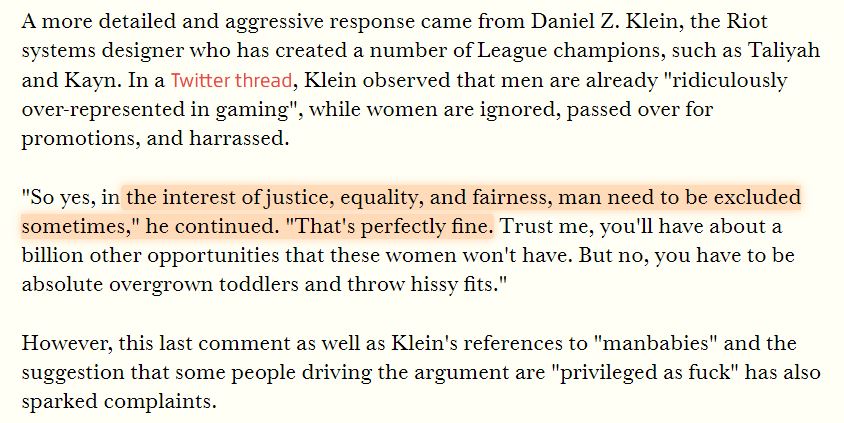
Also in the name of diversity, there is unabashed discrimination against men (especially white men) in tech, in both hiring policies and in other arenas. One such example is this, a developer workshop that specifically excluded men: https://t.co/N0SkH4hR35
USC's Interactive Media & Games Division cancels all-star panel that included top-tier game developers who were invited to share their experiences with students. Why? Because there were no women on the
ElectronConf is a conf which chooses presenters based on blind auditions; the identity, gender, and race of the speaker is not known to the selection team. The results of that merit-based approach was an all-male panel. So they cancelled the conference.
Apple's head of diversity (a black woman) got in trouble for promoting a vision of diversity that is at odds with contemporary progressive dogma. (She left the company shortly after this
Also in the name of diversity, there is unabashed discrimination against men (especially white men) in tech, in both hiring policies and in other arenas. One such example is this, a developer workshop that specifically excluded men: https://t.co/N0SkH4hR35