There's a lot of tasks you work on that are well below your intellectual capability.
Booking haircut appointments, ordering groceries, and finding flights is a waste of time.
First, you want to find out what tasks can you delegate.
Here's how:
Track everything you do every 15 minutes in a spreadsheet. Create 3 columns w/ the below questions
1. Do I like doing this?
2. Is it repeatable?
3. Can it be delegated?
If the answers are No, Yes, Yes -- you've found tasks to delegate!
We'll jump back into these tasks later.
Before we learn how to find them, let's understand the types of VA's:
1. Individual Freelancers (Low cost & High cost)
2. Agency VA's (High cost)
My experience has been with low-cost VA's (under $6/hour). I've gotten the same level of quality that I would with most US VA's.
Now, here's how we craft the right job post to attract the best ones: Be as specific as possible with what you expect. Here’s an example:
Also ask for a screenshot of their computer specs & internet speed results and a 2 min video of their background & why they want the job.
Now, invite the best VA’s to interview for your job.
To do this, you’ll go search for VA’s and apply the following filters to find the best ones. These are the Upwork filters:
- $10k+ earned
- Located in Philippines
- 100% job rating
- Native English speaker
- No Agencies
Block off 4 hours across 2 days. Send a calendly link with 15-minute time slots for people to come interview.
Invite the people that have the highest number of $ earned and have worked the most hours with a 100% job approval rating to join and your time slots get filled
Here's how the 16 interviews will go:
- 8 people won't show up or have good enough English skills (Immediately eliminated)
- 8 people will be considered.
Here’s the questions that I ask the 2nd group:
The questions you want to ask:
1. Basic requirements – examples: tell me about yourself, why you want this job
2. Thinking on your feet questions - examples: won't you burn out working U.S. hours?
3. Culture fit questions – examples: tell me about your worst boss
From those remaining 8 people, you’ll have 1-2 that are a good fit. You can either offer them both the job as a test period for 60 days or offer it to just 1 of them.
You’ll tell them that the 1st 60 days will be a pilot where you both are testing each other out.
Now you have your VA ready to go! It's time to begin delegating.
This is where most people screw up. Because they don't CLEARLY give instructions to their VA's.
Remember, your VA cannot read your mind. Over time, they'll learn how you like things done.
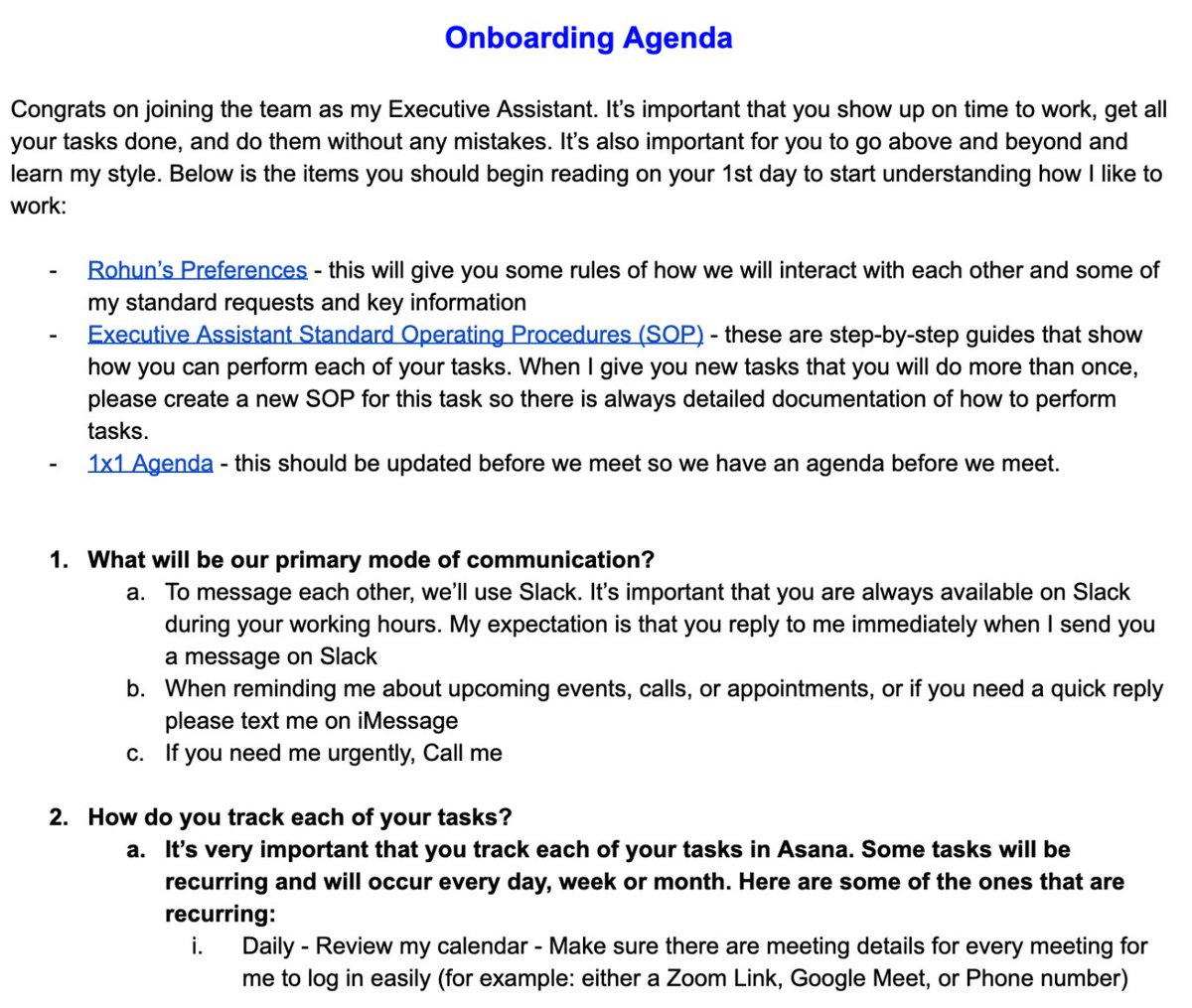
The 1st step: Create an Onboarding Agenda. This includes
1- How you like to Communicate (Slack, Asana, Text, etc.)
2 - How your VA should keep you up to date on tasks
3 - How often do you meet
Here's a snippet of mine:
Next, you'll create a Preferences document. This includes things like
1 - Your business entity info
2 - Your Meeting invite preferences (Zoom, days you like meetings, etc.)
3 - How to do research
4 - Personal info (address, phone #, TSA Precheck #.)
Third, you'll want to go back to the original tasks that you wrote down that you want to delegate.
You should create Loom videos for each one showing how you perform each task.
Your VA will then start doing these tasks and ask any questions.
In addition to that they will then create SOPs with detailed written instructions for how to perform the tasks in addition to having the Loom video.
This helps make sure that you're capturing each task in the future for any new VA's you hire.
Note this important mindset shift. You're not creating SOPs -- your VA is. You take a quick video of you doing the task but then you have the VA execute SOP creation.
This mindset shift is important.
You're beginning to give up control. It's small, but important.
@david_perell also has a good framework of how to delegate tasks:
1 - Outline the vision
2 - Share resources
3 - Describe your Definition of Done
https://t.co/BlG0ytJp0U
Remember: arguably the most important point — you need to give clear, detailed, and specific instructions for tasks otherwise the entire system will fail.
@ramit has good examples of email templates to communicate with VA's on the
@tferriss blog:
https://t.co/FjOHF44D76
This is a bad vs. good example:
Bad: Pls book a dinner for me this Friday
Good: Pls book dinner on Opentable for me on 2/19 for 2 ppl in downtown Austin at 6:00 pm. Mexican restaurant that has tacos. Slack me the yelp page of the restaurant before you book so I can confirm.
You're off to the races! A few other helpful tips:
1. The first week meet for 1 hour everyday
2. In the beginning it takes time, but this is an investment that will pay off by giving you back time
3. Don't create work just because you have a VA
4. If you can automate, do that!