When George HW Bush took office in 1989, Iran was not near the top of a foreign policy agenda dominated by deterioration of USSR, potential reunification of Germany, and turmoil in China. Iran was severely weakened and its nuclear program and regional influence was limited. 2/15
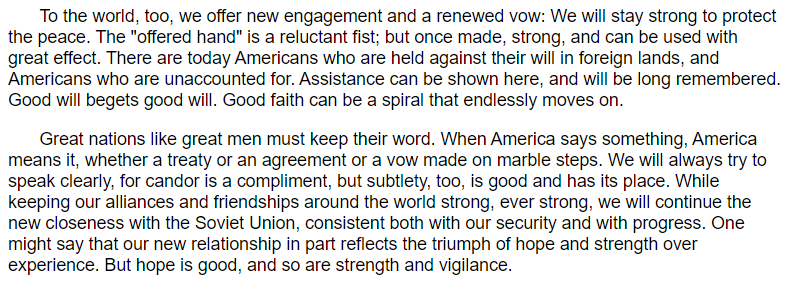
But Iran-aligned groups continued to hold Americans hostage in Lebanon, an issue that weighed on Bush as it did Reagan. In his inaugural, Bush called on Iran to help bring home those Americans, pledging that "good will begets good will." 3/15
For Bush, resolving the hostage issue was the "sine qua non" of improved relations with Iran.
He signed a classified policy directive instructing US to "be prepared for a normal relationship with Iran" and authorized the beginning of indirect negotiations. 4/15
Iran took the offer seriously, and President Rafsanjani worked to secure the release of hostages, via the tireless UN envoy Giandomenico Picco.
By the end of 1991, all Americans were freed from Lebanon. The US began to offer some promised "good will" in response. 5/15
US paid compensation for Iranian military materiel impounded after 1979; it permitted US companies to import Iranian oil; and it supported the UN's judgement at the end of 1991 that Iraq was responsible for the Iran-Iraq War, a longstanding Iranian demand. 6/15
But the US recognized that Iran expected more "good will," and it initiated a policy review in late 1991/early 1992 to decide "Should goodwill now beget goodwill?" in the words of Bruce Riedel, who served on the NSC at the time. 7/15
The decision was "no." The policy review concluded in April 1992 that not only should "goodwill not beget goodwill," but Iran was a threat that needed to be contained.
It was a contradiction of Bush's inaugural pledge that left Rafsanjani out to dry. Why?
8/15
The answer has to do with an expansion of Iranian nuclear and terrorist activity during precisely the time of the policy review.
This included the March 1992 suicide attack on the Israeli embassy in Buenos Aires, carried out by Hezbollah. 9/15
At the same time, Iran engaged in a wide-ranging campaign to acquire sensitive pieces of nuclear technology. Tehran expanded nuclear ties with China, India, Argentina, Germany, and Russia, at a scale and scope that concerned US officials. 10/15
Much of this technology has plausible civilian applications. But this Iranian campaign came a time of shifting attitudes towards "dual use" technology and a rising sensitivity about the risks of nuclear proliferation, given the dissolution of USSR and secret Iraqi program. 11/15
This led the CIA to publicly assess for the first time that Iran was "seeking to acquire a nuclear weapon capability. Barring significant. technical input from abroad, however, the Iranians are not likely to achieve that goal before the year 2000." 12/15
Due to both terrorism and growing concerns about Iran's nuclear weapons ambitions, good will did not beget good will.
The Bush administration pivoted to a much more forward-leaning posture toward Iran, which Clinton adopted in his "Dual Containment" policy. 13/15
A final note: Israel played essentially no role in the US conclusion that Iran represented a threat. Remarkably, Israeli leaders were so nonplussed about Iran that the military intelligence directorate had closed its Iran office by 1990. 14/15
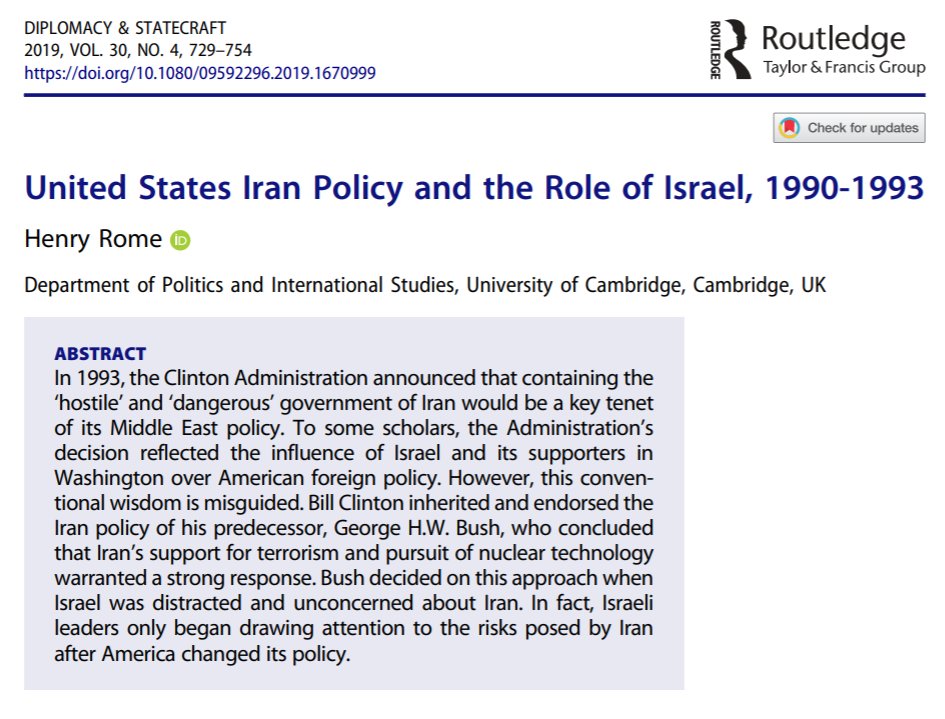
More details are in my journal article, "United States Iran Policy and the Role of Israel, 1990-1993," including more about Israel's threat perceptions and the impact of the Gulf War on US-Iran ties.
https://t.co/pN6O5lOBHa 15/15