10 Lessons From (the book you still haven't read) Atomic Habits by James Clear:
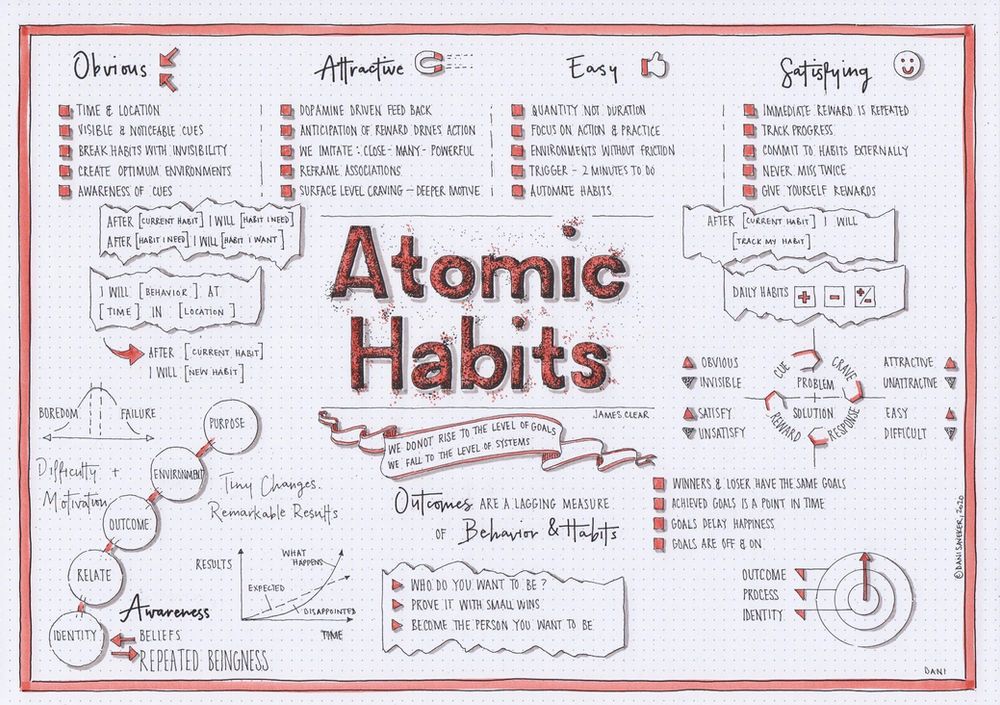
We all have habits, whether good or bad. The problem is that most people don't realize how much power their habits have over their lives.

Bad habits repeat themselves repeatedly, not because you don't want to change, but because you have the wrong system for change.
Changes that seem small and unimportant initially will compound into remarkable results if you're willing to stick with them for years.
That's why it's so important to develop good habits and break bad ones.

Here are 10 lessons from Atomic Habits by James Clear that can help you do that.
1. Make it easy to start
The easier it is to begin your new habit, the more likely you will stick with it.

If you want to start running, for instance, don't make a goal of running 5 miles a day.
Start by going for a short walk around the block.

Once that becomes easy, add more each time until you're up to your goal.
2. Form a cue or trigger

Cues are habits that trigger other habits.

For example, brushing your teeth is a cue that triggers the habit of flossing.

If you want to form a new habit, find an existing cue that you can use to trigger it.
3. Create a craving

When you have a craving for something, you're more likely to act on it.

So if you want to form a new habit, find a way to create a craving for it.

For example, if you want to eat healthily, ensure healthy snacks are visible and easily accessible.
4. Make it satisfying

The more satisfying your new habit is, the more likely you will stick with it.

If you're trying to eat healthily, make sure you're eating foods you enjoy and filling you up.
5. Set a goal

Goals give you something to strive for and help keep you motivated.

When setting a goal for your new habit, make sure it's specific, measurable, achievable, relevant, and time-bound (SMART).
6. Set a deadline

If you want to make sure you stick with your new habit, set a deadline for yourself.

For example, if you want to start working out, make a goal of working out three times a week for six weeks.
7. Make a plan

When you have a plan, you're more likely to follow your habits.

So if you want to make sure you're sticking to your new habit, plan how you will do it.

The first plan you make likely won't work, so adjust it as needed.
8. Get an accountability partner

Having someone to keep you accountable can be a great way to make sure you're sticking to your habits.

Find someone with a similar goal and check in with each other regularly to see how you're doing.
9. Reward yourself

When you reach your goals, reward yourself!

This will help motivate you to keep going and make it more likely that you'll stick with your habits.

The reward can be big or small; it doesn't matter as long as it's unique.
10. Keep track of your progress

Tracking your progress is a great way to stay motivated and on track with your habits.

Use a journal or app to track your new habit and how well you're doing.

This will help you see your progress and keep moving forward.
Summary:

Developing good habits can be hard, but it's worth it.

These 10 lessons from Atomic Habits by James Clear can help you get started.
Just remember to...

Plan
Set a goal
Find a cue
Start small
Make it easy
Set a deadline
Create a craving
Make it satisfying
Track your progress
Get an accountability partner

You can do it; just keep going!
Thank you for reading; I hope you enjoy these tips from James Clear!

If you got value from this, follow me
@aaronjgolub for more content.

You May Also Like

THE MEANING, SIGNIFICANCE AND HISTORY OF SWASTIK

The Swastik is a geometrical figure and an ancient religious icon. Swastik has been Sanatan Dharma’s symbol of auspiciousness – mangalya since time immemorial.


The name swastika comes from Sanskrit (Devanagari: स्वस्तिक, pronounced: swastik) &denotes “conducive to wellbeing or auspicious”.
The word Swastik has a definite etymological origin in Sanskrit. It is derived from the roots su – meaning “well or auspicious” & as meaning “being”.


"सु अस्ति येन तत स्वस्तिकं"
Swastik is de symbol through which everything auspicios occurs

Scholars believe word’s origin in Vedas,known as Swasti mantra;

"🕉स्वस्ति ना इन्द्रो वृधश्रवाहा
स्वस्ति ना पूषा विश्ववेदाहा
स्वस्तिनास्तरक्ष्यो अरिश्तनेमिही
स्वस्तिनो बृहस्पतिर्दधातु"


It translates to," O famed Indra, redeem us. O Pusha, the beholder of all knowledge, redeem us. Redeem us O Garudji, of limitless speed and O Bruhaspati, redeem us".

SWASTIK’s COSMIC ORIGIN

The Swastika represents the living creation in the whole Cosmos.


Hindu astronomers divide the ecliptic circle of cosmos in 27 divisions called
https://t.co/sLeuV1R2eQ this manner a cross forms in 4 directions in the celestial sky. At centre of this cross is Dhruva(Polestar). In a line from Dhruva, the stars known as Saptarishi can be observed.
राम-रावण युद्ध समाप्त हो चुका था। जगत को त्रास देने वाला रावण अपने कुटुम्ब सहित नष्ट हो चुका था।श्रीराम का राज्याभिषेक हुआ और अयोध्या नरेश श्री राम के नेतृत्व में चारों दिशाओं में शन्ति थी।
अंगद को विदा करते समय राम रो पड़े थे ।हनुमान को विदा करने की शक्ति तो राम में थी ही नहीं ।


माता सीता भी हनुमान को पुत्रवत मानती थी। अत: हनुमान अयोध्या में ही रह गए ।राम दिनभर दरबार में, शासन व्यवस्था में व्यस्त रहते थे। संध्या को जब शासकीय कार्यों में छूट मिलती तो गुरु और माताओं का कुशल-मंगल पूछ अपने कक्ष में जाते थे। परंतु हनुमान जी हमेशा उनके पीछे-पीछे ही रहते थे ।


उनकी उपस्थिति में ही सारा परिवार बहुत देर तक जी भर बातें करता ।फिर भरत को ध्यान आया कि भैया-भाभी को भी एकांत मिलना चाहिए ।उर्मिला को देख भी उनके मन में हूक उठती थी कि इस पतिव्रता को भी अपने पति का सानिध्य चाहिए ।

एक दिन भरत ने हनुमान जी से कहा,"हे पवनपुत्र! सीता भाभी को राम भैया के साथ एकांत में रहने का भी अधिकार प्राप्त है ।क्या आपको उनके माथे पर सिन्दूर नहीं दिखता?इसलिए संध्या पश्चात आप राम भैया को कृप्या अकेला छोड़ दिया करें "।
ये सुनकर हनुमान आश्चर्यचकित रह गए और सीता माता के पास गए ।


माता से हनुमान ने पूछा,"माता आप अपने माथे पर सिन्दूर क्यों लगाती हैं।" यह सुनकर सीता माता बोलीं,"स्त्री अपने माथे पर सिन्दूर लगाती है तो उसके पति की आयु में वृद्धि होती है और वह स्वस्थ रहते हैं "। फिर हनुमान जी प्रभु राम के पास गए ।
A THREAD ON @SarangSood

Decoded his way of analysis/logics for everyone to easily understand.

Have covered:
1. Analysis of volatility, how to foresee/signs.
2. Workbook
3. When to sell options
4. Diff category of days
5. How movement of option prices tell us what will happen

1. Keeps following volatility super closely.

Makes 7-8 different strategies to give him a sense of what's going on.

Whichever gives highest profit he trades in.


2. Theta falls when market moves.
Falls where market is headed towards not on our original position.


3. If you're an options seller then sell only when volatility is dropping, there is a high probability of you making the right trade and getting profit as a result

He believes in a market operator, if market mover sells volatility Sarang Sir joins him.


4. Theta decay vs Fall in vega

Sell when Vega is falling rather than for theta decay. You won't be trapped and higher probability of making profit.
"I really want to break into Product Management"

make products.

"If only someone would tell me how I can get a startup to notice me."

Make Products.

"I guess it's impossible and I'll never break into the industry."

MAKE PRODUCTS.

Courtesy of @edbrisson's wonderful thread on breaking into comics –
https://t.co/TgNblNSCBj – here is why the same applies to Product Management, too.


There is no better way of learning the craft of product, or proving your potential to employers, than just doing it.

You do not need anybody's permission. We don't have diplomas, nor doctorates. We can barely agree on a single standard of what a Product Manager is supposed to do.

But – there is at least one blindingly obvious industry consensus – a Product Manager makes Products.

And they don't need to be kept at the exact right temperature, given endless resource, or carefully protected in order to do this.

They find their own way.