
@GunduHuDuGa That's a good qsn, if not a bit nuanced. Avataras are of many varieties and frankly, most of the classification is only for our understanding and not really binding on Paramatma Himself. We can take several approaches to understanding this. If you go by a Vedantic approach,+
Varaha janmani bhabhuvuramee samudra |
Tam naama naadamaravindha drusham Yasoda
Paanidwayantara jalai snapayaam bhabhoova ||
More from Johnny Silverhand
Good question. A little background info first to put things in perspective. Brahman has no form. It is an experience. However, for upaasana certain forms are ascribed to it by Vedas which fully encapsulate the actual tatvam of Brahman. So when a certain form is chosen for upasana
several things are ascribed to that form - a recognition of its power, Sakti, which is a feminine quality and hence worshiped as a consort, parivaara devataas (ones who always serve that form and show others how it's done), and a vaahana. Here, Vaahana does not only mean
a vehicle. Vaahana is actually a conduit. It tells you what kind of devotion is required in order to be always in service of that diety and to be chosen by that form. Vaahana is also an insignia or a Dwajam that espouses the gunas of that diety.
Now, coming to the question. Hanuman is usually worshiped as Raamadaasa, Raamadhuta, etc. However, there are Hanumadh upaasakas who specifically worship Hanuman as Brahman complete with Avataras. There are many mantra sastras that support this. In fact, they say Ha nu ma
are subtle syllables within the A U Ma Omkara itself, which means one needs to probe deep in order to understand the actual Hanumad tatvam. Hanuman is really a Brahmachari no doubt but, like I said above, upasana vidhis require that He be worshiped with a consort and vaahana
I need your opinion on something else as well...
— Kishore C Iyer\U0001f1ee\U0001f1f3 (@Kishoreciyer1) March 28, 2021
There is story of Camel being the vahanam of Hanuman... how true is it? Seems very prevalent in Telegu literature!
several things are ascribed to that form - a recognition of its power, Sakti, which is a feminine quality and hence worshiped as a consort, parivaara devataas (ones who always serve that form and show others how it's done), and a vaahana. Here, Vaahana does not only mean
a vehicle. Vaahana is actually a conduit. It tells you what kind of devotion is required in order to be always in service of that diety and to be chosen by that form. Vaahana is also an insignia or a Dwajam that espouses the gunas of that diety.
Now, coming to the question. Hanuman is usually worshiped as Raamadaasa, Raamadhuta, etc. However, there are Hanumadh upaasakas who specifically worship Hanuman as Brahman complete with Avataras. There are many mantra sastras that support this. In fact, they say Ha nu ma
are subtle syllables within the A U Ma Omkara itself, which means one needs to probe deep in order to understand the actual Hanumad tatvam. Hanuman is really a Brahmachari no doubt but, like I said above, upasana vidhis require that He be worshiped with a consort and vaahana
This nonsense stems due to "reading" Vedas like any other book. There seems to be some confusion even among traditional aasthikas regarding this and I've seen even upanyasarks talking nonsense. However, one must know the proper way of understanding Vedam. Let's take an eg. +
When you use your limbs for doing work, do you say Mr. Hand has lifted an object or Mr. Legs have taken you to a place? No, right? You say my hands and my legs. How come they are "your" hands and legs when they are clearly independent entities? That means you associate your+
limbs with your being. The results of their work is enjoyed by your "Self" and not by the limbs themselves. Similarly, all Devatas are angaas or limbs of the Paramatma. Whatever duties they carry out are under His supervision and their adulation goes to Him ultimately.+
Just like how a CEO represents all employees and each person's achievements directly reflect on the company, a particular Devata say Indra's duty is work delegated by Paramatma and when that goes astray, He takes upon Himself to rectify the same.
Aakaasaat pathitham thoyam yadaagacchathi saagaram sarvadeva namaskara: Kesavam (or Sankaram) prathigacchathi. Just like how different drops of rain ultimately merge into the sea, adulations of all dieties ultimately reaches the One Supreme Brahman.+
Vishnu\xa0is a Rigvedic deity, but not a prominent one when compared to Indra, Agni and others Just 5 out of 1028 hymns of the Rigveda are dedicated to\xa0Vishnu, although He is\xa0mentioned\xa0in other hys He is also described in the Vedic literature as the one who supports heaven and earth
— Vamangi (@RudraaShiv) January 1, 2021
When you use your limbs for doing work, do you say Mr. Hand has lifted an object or Mr. Legs have taken you to a place? No, right? You say my hands and my legs. How come they are "your" hands and legs when they are clearly independent entities? That means you associate your+
limbs with your being. The results of their work is enjoyed by your "Self" and not by the limbs themselves. Similarly, all Devatas are angaas or limbs of the Paramatma. Whatever duties they carry out are under His supervision and their adulation goes to Him ultimately.+
Just like how a CEO represents all employees and each person's achievements directly reflect on the company, a particular Devata say Indra's duty is work delegated by Paramatma and when that goes astray, He takes upon Himself to rectify the same.
Aakaasaat pathitham thoyam yadaagacchathi saagaram sarvadeva namaskara: Kesavam (or Sankaram) prathigacchathi. Just like how different drops of rain ultimately merge into the sea, adulations of all dieties ultimately reaches the One Supreme Brahman.+
A little late, but here goes:
Andhariki hrudayapurvaka Shubhakrit naama Yugaadi Shubhkankshalu
Ellarigu hritpurvaka Shubhakrit naama Yugaadi habbada Shubhashayagalu
Sarvaana Gudipaadavyaaccha khupa khupa Shubeccha
May Srinivasa bless everyone with Aayu: Aarogyam, and Aishwaryam
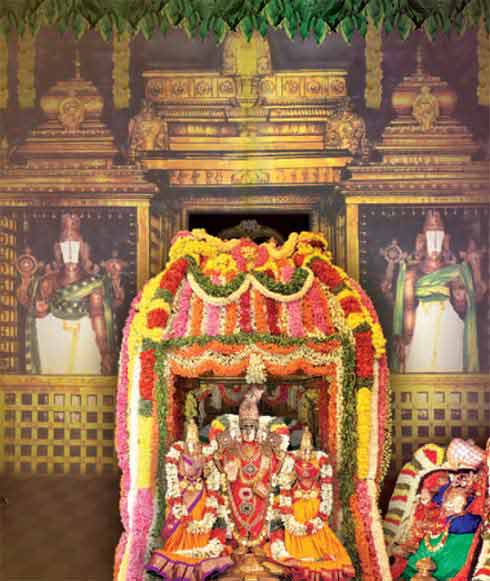
Ugadi isnt a mere start to a new year. As always with Bharatiya sampradayas, there's a lot of Rishi vignaana that brings together the physical, metaphysical, and the Absolute onto one plane for our overall material and spiritual growth. This thread talks about a few such aspects.
Unlike other cultures around the world, Bhaaratiya civilization is the only one to properly understand the dynamic nature of time and its implications on sentient and non-sentient beings.
We have discussed some of these concepts earlier while trying to understand the significance of Deepavali.
Vidura explains in the Mahabharata,
Kaala: pachathi bhutaani kaala: samharate prajaa: |
Kaala: suptheshu jaagarthi kaalo hi duratikrama: ||
Time eats all beings, time kills everyone. Time is awake when you are asleep. Time is insurmountable.
Andhariki hrudayapurvaka Shubhakrit naama Yugaadi Shubhkankshalu
Ellarigu hritpurvaka Shubhakrit naama Yugaadi habbada Shubhashayagalu
Sarvaana Gudipaadavyaaccha khupa khupa Shubeccha
May Srinivasa bless everyone with Aayu: Aarogyam, and Aishwaryam
Ugadi isnt a mere start to a new year. As always with Bharatiya sampradayas, there's a lot of Rishi vignaana that brings together the physical, metaphysical, and the Absolute onto one plane for our overall material and spiritual growth. This thread talks about a few such aspects.
Unlike other cultures around the world, Bhaaratiya civilization is the only one to properly understand the dynamic nature of time and its implications on sentient and non-sentient beings.
We have discussed some of these concepts earlier while trying to understand the significance of Deepavali.
Time plays a very important role in shaping our lives. Everything is a function of time, which is why Time is a form of Paramatma. We have Siva worshipped as Mahaakaal in Ujjain, Ambal worshipped as Kaali; in fact, Kaali puja is an integral component of Deepavali celebrations in
— Master Chief Spartan (@SparesofWar) November 4, 2021
Vidura explains in the Mahabharata,
Kaala: pachathi bhutaani kaala: samharate prajaa: |
Kaala: suptheshu jaagarthi kaalo hi duratikrama: ||
Time eats all beings, time kills everyone. Time is awake when you are asleep. Time is insurmountable.
Haha. Fool. On the day of Deepavali Amavasya, abhyangana snaana, pitru tarpanam, deepa daanam, ulka darsanam, and Lakshmi puja are performed. Deepa daana is not some Buddhist creation. The concept of even the wicks in a Deepam is highly Vedic, so it is impossible that what is
essentially a naasitka vaada will even promulgate something about Deepam, let alone Deepa Daanam. It is that time of the year again — an auspicious occasion of Deepavali marked by festivities, exchange of pleasantries, sumptuous food, crackers! and of course, Bhagavan's blessings
However, this is also the time when a lot of misinfo, faltu gnaan, and unsolicited advice start pouring in from the usual suspects. I don't necessarily fault ThePrint or any such farcical media outlets. They are steadfast in their agenda and they won't change even if one moves
heaven and earth. However, it is important to call out blatant misappropriation for our own good and know why we celebrate certain festivals.
Let's understand what Deepavali is all about. Now, the festival means many things to many people and there are too many variations in how
it is celebrated across the world. That being said, I will try to present some aspects that form the core of it all.
As always, every festival, every act, and every ritual in SD is extensively deep-rooted in philosophy that addresses both iha and para.
'Diwali isn\u2019t what you thought it was\u2014It\u2019s actually Deep Daan Utsav, a Buddhist festival'
— ThePrintIndia (@ThePrintIndia) November 4, 2021
Kalyani @FiercelyBahujan, PhD scholar, JNU, writes#ThePrintOpinionhttps://t.co/wbNjbeRYmq
essentially a naasitka vaada will even promulgate something about Deepam, let alone Deepa Daanam. It is that time of the year again — an auspicious occasion of Deepavali marked by festivities, exchange of pleasantries, sumptuous food, crackers! and of course, Bhagavan's blessings
However, this is also the time when a lot of misinfo, faltu gnaan, and unsolicited advice start pouring in from the usual suspects. I don't necessarily fault ThePrint or any such farcical media outlets. They are steadfast in their agenda and they won't change even if one moves
heaven and earth. However, it is important to call out blatant misappropriation for our own good and know why we celebrate certain festivals.
Let's understand what Deepavali is all about. Now, the festival means many things to many people and there are too many variations in how
it is celebrated across the world. That being said, I will try to present some aspects that form the core of it all.
As always, every festival, every act, and every ritual in SD is extensively deep-rooted in philosophy that addresses both iha and para.
More from All







You May Also Like





Keep dwelling on this:
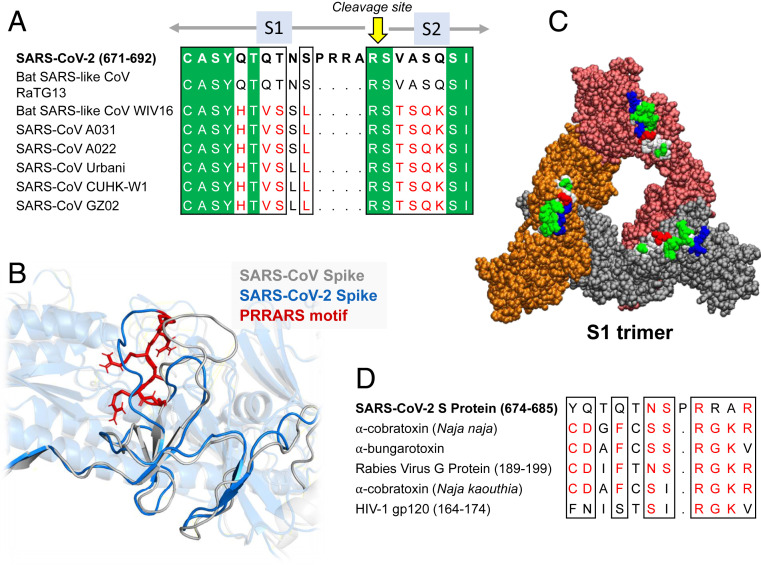
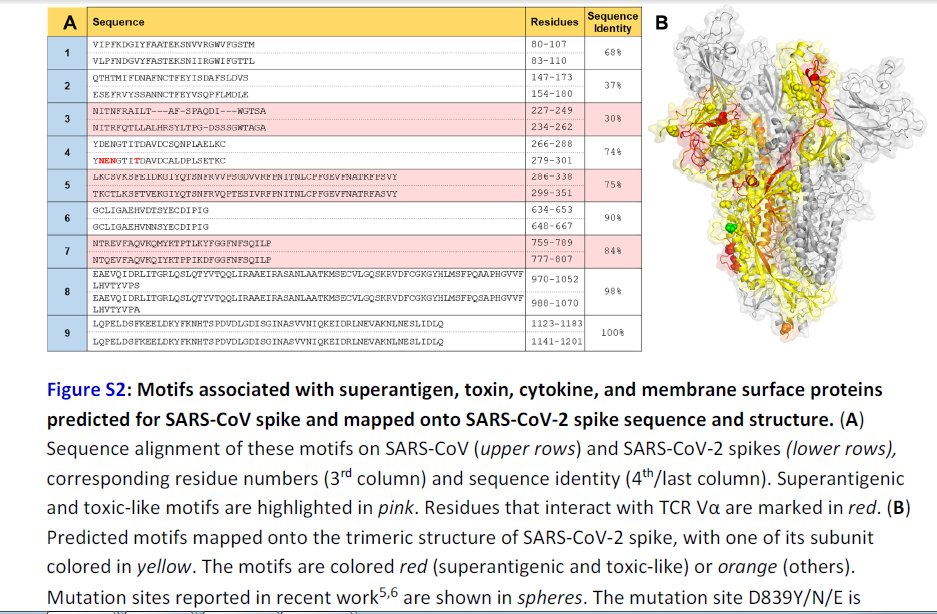
Further Examination of the Motif near PRRA Reveals Close Structural Similarity to the SEB Superantigen as well as Sequence Similarities to Neurotoxins and a Viral SAg.
The insertion PRRA together with 7 sequentially preceding residues & succeeding R685 (conserved in β-CoVs) form a motif, Y674QTQTNSPRRAR685, homologous to those of neurotoxins from Ophiophagus (cobra) and Bungarus genera, as well as neurotoxin-like regions from three RABV strains
(20) (Fig. 2D). We further noticed that the same segment bears close similarity to the HIV-1 glycoprotein gp120 SAg motif F164 to V174.
https://t.co/EwwJOSa8RK
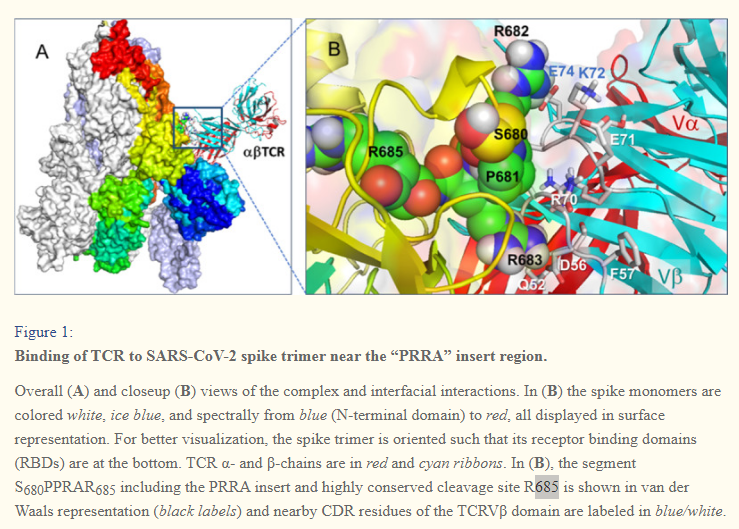
In (B), the segment S680PPRAR685 including the PRRA insert and highly conserved cleavage site *R685* is shown in van der Waals representation (black labels) and nearby CDR residues of the TCRVβ domain are labeled in blue/white
https://t.co/BsY8BAIzDa
Sequence Identity %
https://t.co/BsY8BAIzDa
Y674 - QTQTNSPRRA - R685
Similar to neurotoxins from Ophiophagus (cobra) & Bungarus genera & neurotoxin-like regions from three RABV strains
T678 - NSPRRA- R685
Superantigenic core, consistently aligned against bacterial or viral SAgs
Further Examination of the Motif near PRRA Reveals Close Structural Similarity to the SEB Superantigen as well as Sequence Similarities to Neurotoxins and a Viral SAg.
The insertion PRRA together with 7 sequentially preceding residues & succeeding R685 (conserved in β-CoVs) form a motif, Y674QTQTNSPRRAR685, homologous to those of neurotoxins from Ophiophagus (cobra) and Bungarus genera, as well as neurotoxin-like regions from three RABV strains
(20) (Fig. 2D). We further noticed that the same segment bears close similarity to the HIV-1 glycoprotein gp120 SAg motif F164 to V174.
https://t.co/EwwJOSa8RK
In (B), the segment S680PPRAR685 including the PRRA insert and highly conserved cleavage site *R685* is shown in van der Waals representation (black labels) and nearby CDR residues of the TCRVβ domain are labeled in blue/white
https://t.co/BsY8BAIzDa
Sequence Identity %
https://t.co/BsY8BAIzDa
Y674 - QTQTNSPRRA - R685
Similar to neurotoxins from Ophiophagus (cobra) & Bungarus genera & neurotoxin-like regions from three RABV strains
T678 - NSPRRA- R685
Superantigenic core, consistently aligned against bacterial or viral SAgs
