You don't get what you deserve.

You get what you negotiate.

9 tips to master negotiation (in life and business):

Negotiation is one of the highest ROI skills.

You will:

• Earn more (job salary, client deals)
• Save more (home or car purchases)
• Win more (controlling the TV remote)

9 powerful tips, here we go...
1. Prepare (‘I FORESAW IT’ Framework)

“If you fail to plan, you are planning to fail” —Ben Franklin

Use this checklist to plan for any big negotiation.

Preparation (like this) will give you confidence and influence.

Credit: Prof. Seth Freeman
2. Hone Your Body Language (7-38-55 Rule)

People will like/dislike your communication based on:

• 7% words
• 38% tonality and face
• 55% body language

Stand up straight, pull your shoulders back, make eye contact, smile, give a firm handshake...

You will be dangerous.
3. Use the Word “Fair”

“The most powerful word in negotiations is ‘Fair.’

Say: ‘I want you to feel like you are being treated fairly at all times. So please stop me at any time if I’m being unfair, and we’ll address it.’” —Chris Voss

Show them respect, set the tone.
4. Make the First Offer

Old-school advice says to wait for them to reveal the first number

(so you don't short-change yourself).

New studies show its often better to go first,

due to a powerful “anchoring effect”...
Rule of thumb:

If you know the bargaining range,

Go first at an extreme high (or low).

You’ll anchor the negotiation to that number.
5. Ask Open-Ended Questions

Understanding the other side’s needs is crucial.

Never Assume! Ask questions to uncover creative solutions.

Use ‘What’ & 'How' Q's:

• What about this is important to you?
• What about this doesn’t work for you?
• How will we know we’re on track?
6. Sidestep Killer Questions

Avoid weak positions resulting from tough questions.

Killer Questions:
• How much are you currently making?
• How much do you expect to make?

Sidesteps:
• I have a rule not to discuss that.
• I’d like to know the salary bands for this role.
7. Be Soft on Person, Hard on Problem

Always treat your counterpart with dignity.

If there’s a problem, focus on the facts.

Facts are more persuasive and less controversial.

Don’t say: “This is a cheap company.”

Say: “Comparable industry roles pay [x].”
8. Vocalize Potential Losses From No Deal

Use this formula to heighten emotions and motivate:

If we agree (list their benefits),
If we disagree (relist benefits as LOST, plus other pain points).

Loss Aversion says, people go to extreme lengths to avoid *perceived* losses.
9. End Positive (Oprah Rule)

Recency Bias describes our tendency to emphasize whatever occurred LAST.

In negotiation don’t take cheap shots, complain, or try to get more leverage at the end.

Oprah is a famous negotiator who makes her last touchpoint a positive one...
“Say something both indisputably positive and indisputably true at the end:

‘I’d love for us to be able to work this out productively so we can have a long and prosperous relationship.’”

—Chris Voss
Want to dive deeper into negotiation?

3 books I recommend:

• Great Courses: The Art of Negotiating the Best Deal (Audible) by Seth Freeman

• You Don't Get What You Deserve, You Get What You Negotiate by Chester Louis Karrass

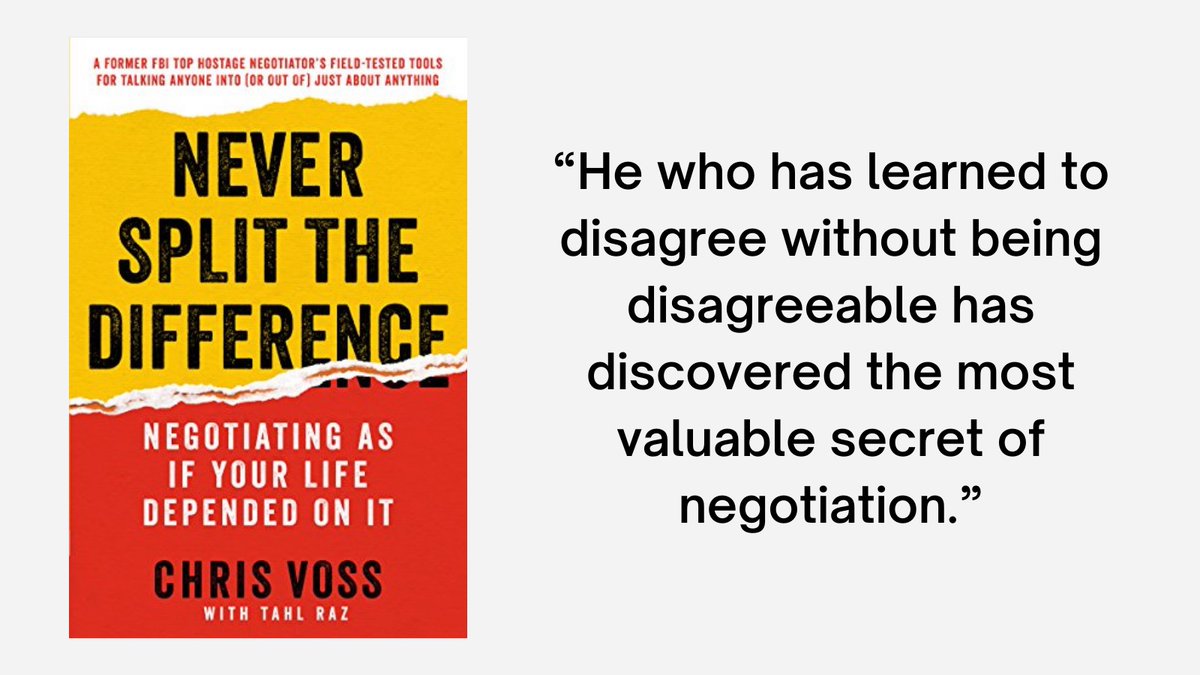
• Never Split the Difference by Chris Voss
TL;DR Negotiation Tips

1. Prepare (‘I FORESAW IT’)
2. Hone Your Body Language
3. Use the Word 'Fair'
4. Make the First Offer
5. Ask Open-Ended Questions
6. Sidestep Killer Questions
7. Be Soft on Person, Hard on Problem
8. Vocalize Potential Losses
9. End Positive (Oprah Rule)
Thanks for reading! Follow me @SystemSunday for more content like this.

https://t.co/aRbb8i1C5q
P.S. If you like high-performance living, you will love my weekly newsletter (it’s free).

Every Sunday I feature the best tech products for wealth, health, and free time.

Try it here:
https://t.co/pjCfCFXgYo

More from Ben Meer

10 free websites so useful they should come pre-bookmarked on every browser:

1. Quillbot

A free paraphrasing website (popular among students).

• Input text and hit Rephrase
• Get AI-inspiration on how to rewrite
• Scan text for plagiarism (built-in feature)
• Credit sources

https://t.co/JBf4rpT9zF


2. 12ft Ladder

Want to read an article, but there’s a paywall?

Simply insert the URL into 12ft Ladder.

All sites have a non-paywall version they send to Google for SEO.

12ft finds the cached, un-paywalled version of the page.

Now you’re in.

https://t.co/E5vBxDGils


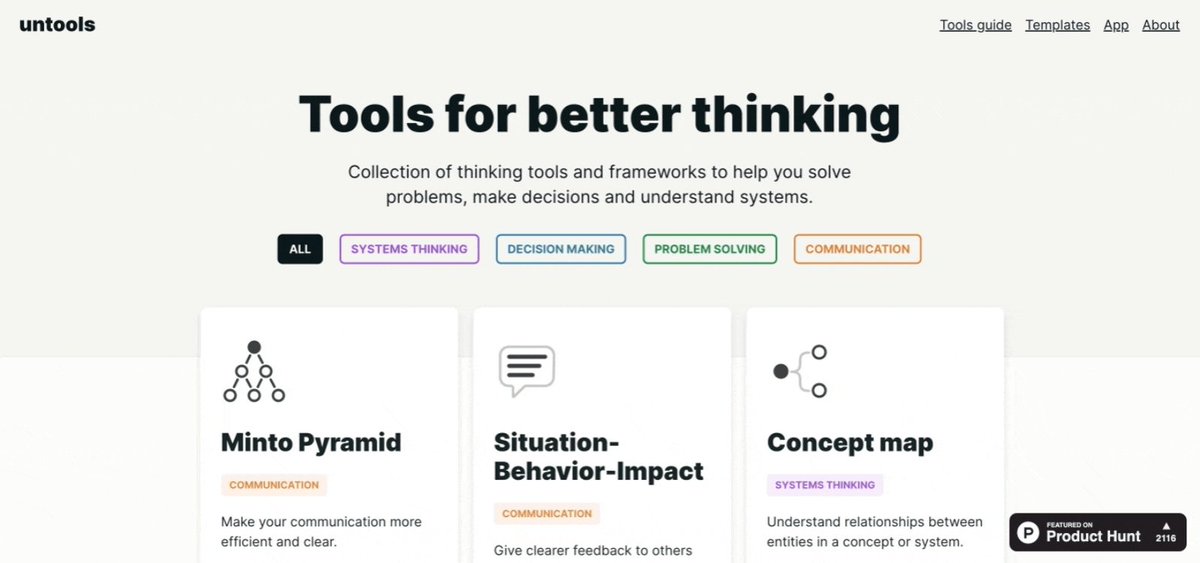
3. Untools

Benefit from a collection of thinking tools and frameworks.

Categories include:

• Systems thinking
• Decision making
• Problem solving
• Communication

https://t.co/vMgngVKMow


4. UnrollMe

Is your inbox overflowing with email subscriptions?

Use UnrollMe to bulk unsubscribe (it's free).

Another cool feature? “Roll-up” subscriptions into a single email.

You’ll be *many* steps closer to inbox zero.

https://t.co/uukYkPgbRv
The best morning routine?

Starts the night before.

9 evening habits that make all the difference:

1. Write down tomorrow's 3:3:3 plan

• 3 hours on your most important project
• 3 shorter tasks
• 3 maintenance activities

Defining a "productive day" is crucial.

Or else you'll never be at peace (even with excellent output).

Learn more


2. End the workday with a shutdown ritual

Create a short shutdown ritual (hat-tip to Cal Newport). Close your laptop, plug in the charger, spend 2 minutes tidying your desk. Then say, "shutdown."

Separating your life and work is key.

3. Journal 1 beautiful life moment

Delicious tacos, presentation you crushed, a moment of inner peace. Write it down.

Gratitude programs a mindset of abundance.

4. Lay out clothes

Get exercise clothes ready for tomorrow. Upon waking up, jump rope for 2 mins. It will activate your mind + body.

More from All

How can we use language supervision to learn better visual representations for robotics?

Introducing Voltron: Language-Driven Representation Learning for Robotics!

Paper: https://t.co/gIsRPtSjKz
Models: https://t.co/NOB3cpATYG
Evaluation: https://t.co/aOzQu95J8z

🧵👇(1 / 12)


Videos of humans performing everyday tasks (Something-Something-v2, Ego4D) offer a rich and diverse resource for learning representations for robotic manipulation.

Yet, an underused part of these datasets are the rich, natural language annotations accompanying each video. (2/12)

The Voltron framework offers a simple way to use language supervision to shape representation learning, building off of prior work in representations for robotics like MVP (
https://t.co/Pb0mk9hb4i) and R3M (https://t.co/o2Fkc3fP0e).

The secret is *balance* (3/12)

Starting with a masked autoencoder over frames from these video clips, make a choice:

1) Condition on language and improve our ability to reconstruct the scene.

2) Generate language given the visual representation and improve our ability to describe what's happening. (4/12)

By trading off *conditioning* and *generation* we show that we can learn 1) better representations than prior methods, and 2) explicitly shape the balance of low and high-level features captured.

Why is the ability to shape this balance important? (5/12)

You May Also Like

This is NONSENSE. The people who take photos with their books on instagram are known to be voracious readers who graciously take time to review books and recommend them to their followers. Part of their medium is to take elaborate, beautiful photos of books. Die mad, Guardian.


THEY DO READ THEM, YOU JUDGY, RACOON-PICKED TRASH BIN


If you come for Bookstagram, i will fight you.

In appreciation, here are some of my favourite bookstagrams of my books: (photos by lit_nerd37, mybookacademy, bookswrotemystory, and scorpio_books)