1/ The standard textbook explanation is this:
The Fed ⬆️ rates, this ⬆️ borrowing costs for banks and pretty much everyone else.
The story then unfolds:
Interest rates ⬆️, mortgage and credit card rates ⬆️, disposable income 🔽
2/ Now you, the consumer, are spending less money.
When you spend less, firms sell less stuff.
This in turn affects company earnings, and by extension their stock prices.
3/ Tech stocks are particularly sensitive due to the discounted cash flow (DCF) model.
It’s just a way how investors value stocks.
Anticipating what the future cash flow of tech firms is worth today.
4/ The key metric here is the discount factor which lowers the present value of future earnings.
And the discount factor reflects interest rates in the economy.
As interest rates go ⬆️ the present value of future earnings goes 🔽
5/ The larger the expected growth of future earnings => the worse the impact of rising interest rates on valuation.
Remember that most tech stocks have very high expected future earnings.
And as a consequence extremely high valuations.
6/ Yeah, but the Fed is expected to raise rates by, what, 0.5%?
And it hasn't even raised them yet!
Why does that warrant such a big correction?
7/ Remember, markets are always forward looking.
Sure, the Fed didn’t raise rates yet, but the bond market is adapting to *expectations* of 3 to 4 interest rate hikes this year.
8/ Why is that an issue?
Because as the economy overheats - higher exp. growth & higher inflation - the Fed raises it’s federal funds rate
(short-term interest rates basically)
This sends short-term T-yields ⬆️
(the 1-mo, 2-mo, 3-mo, 6-mo rates)
9/ This makes investors worried about an upcoming recession.
They expect short-term rates to fall in the future.
So they buy long-term bonds, thus pushing their price down.
(see this thread for an explanation of how this works)
https://t.co/Cd45dlta8K
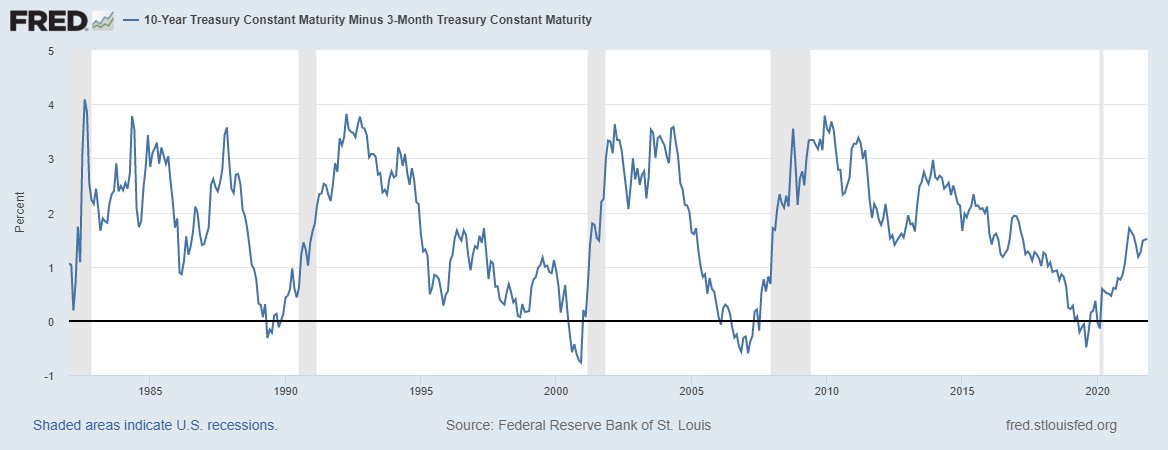
10/ Coupled with the Fed's increase in short-term rates the yield curve begins to flatten and invert.
So we get an *inverted* yield curve - a self-perpetuating mechanism that sends signals to investors and at the same time drives reactions of market actors.
11/ When that happens, when the yield curve inverts, a crisis happens in the next 6 to 9 months.
It becomes a self-fulfilling prophecy.
That's why keep an eye on the spread between the 2 year (& 3-month) yield to the 10 year yield.
12/ Ok, now that the mechanism is clear, what does some empirical research say about this?
Nothing, really.
It depends on the period you look at.
13/ For example this data by Dimensional Fund Advisors shows no relationship between Federal funds rate increase and US stock returns, for the period 1954 to 2016.
Stocks went down 40% of the time, up 60% of the time.
Coin-toss, really.
14/ And this one from BlackRock, counterintuitively, shows a positive relationship!
In this case, a 50bps rise in rates moved equities by 1 p.p.
Their logic is that higher rates are necessary due to a strong economy, and a strong economy implies better earnings.
15/ Conclusion:
Expect sector rotations during corrections: moving from tech to energy or industrials or banks.
Tech? Don’t exit, take some profits and keep holding
(if you have any profits left, that is!)
And also watch out for that yield curve inversion!
Thanks for reading, hope you've enjoyed it :)
Follow me
@wolf_vukovic for more similar stuff on finance, markets and investing.