Egyptian 'nfr' was more like a reference point. They had a concept for the ”base” or ”ground-level,” for their architectural plans. For ex. ”1 cubit above nfr”. And all the nos. would b made by combining multiples of the symbols, so they hd no use for 0 even as a placeholder
THREAD!
You very cleverly picked the facts according to your narrative. And distorted them to subtly establish your false narrative that India is not the originator of Zero. So let me tell you the remaining unlooked facts that you "forgot" and show you the full history of zero.
[THREAD: ZERO]
— Amit Schandillia (@Schandillia) December 2, 2020
1/51
Once upon a time in the land of Mesopotamia, there lived a people who engaged in commerce, had a system of weights and measures, paid in currency, and most importantly, kept written records of all of this in clay tablets. These were the Sumerians.
Egyptian 'nfr' was more like a reference point. They had a concept for the ”base” or ”ground-level,” for their architectural plans. For ex. ”1 cubit above nfr”. And all the nos. would b made by combining multiples of the symbols, so they hd no use for 0 even as a placeholder
The Incas had the decimal system but so did the Harappan people in 3500 B.C.E.
Also, the Incas neither had the Idea of zero as an integer nor did they have a symbol for its representation.
Coming to the Babylonians, their placeholder was not a true zero bcoz it was not used alone, nor was it used at the end of a number. Thus nos. like 2 & 120 (2×60) looked same bcoz the larger nos. lacked a final sexagesimal placeholder. Only context could differentiate them.
And for Greeks, they had no symbol for zero (μηδέν) and did not use a digit placeholder for it. They seemed unsure about the status of zero as a number. They asked themselves, "How can nothing be something?"
Ptolemy, influenced by Hipparchus & Babylonians, ws using a symbol for zero(as shown in pic.) bt again the symbol he ws using ws used by two continuous mathematical functions, one within another, so it meant zero position (minutes of immersion at 1st & last contact), nt none

The Symbol used by Ptolemy changed over time. In the 2nd century was a very small circle with a long overbar. Later, the overbar shortened to only one diameter, similar to the modern o-macron (ō). The overbar was omitted in Byzantine manuscripts, leaving a bare ο (omicron).
This gradual change from an invented symbol to ο disproves the hypothesis that the Omicron was the initial of οὐδέν meaning "nothing". [Neugebauer, otto].
Also, the omicron was being used by the Greeks to represent 70.
Cheers 2 Mayans & Babylonians fr invnting wht is oftn calld as "Placeholders". Bt they were nthing more thn blank spaces or at times two wedge shapes. Wht they did ws solv a practical problem of distinguishing nos. like 89 and 809. They didn't thought of 0 as a concpt or num
No one even dared to think about concept of zero. Until a Rishi from India named Pingal gave the world the first recorded concept of Zero(Shunya). Which is later adopted by other civilisations. Around 250 A.D. India gives first recorded usage of Shunya in the Decimal system
And, then in mid 6th century, an INDIAN named Brahmagupt defined the first recorded rules of modern zero. Wherein Zero is an integer and is an average of -1 and +1.
More from All


https://t.co/6cRR2B3jBE
Viruses and other pathogens are often studied as stand-alone entities, despite that, in nature, they mostly live in multispecies associations called biofilms—both externally and within the host.
https://t.co/FBfXhUrH5d

Microorganisms in biofilms are enclosed by an extracellular matrix that confers protection and improves survival. Previous studies have shown that viruses can secondarily colonize preexisting biofilms, and viral biofilms have also been described.

...we raise the perspective that CoVs can persistently infect bats due to their association with biofilm structures. This phenomenon potentially provides an optimal environment for nonpathogenic & well-adapted viruses to interact with the host, as well as for viral recombination.

Biofilms can also enhance virion viability in extracellular environments, such as on fomites and in aquatic sediments, allowing viral persistence and dissemination.

Viruses and other pathogens are often studied as stand-alone entities, despite that, in nature, they mostly live in multispecies associations called biofilms—both externally and within the host.
https://t.co/FBfXhUrH5d
Microorganisms in biofilms are enclosed by an extracellular matrix that confers protection and improves survival. Previous studies have shown that viruses can secondarily colonize preexisting biofilms, and viral biofilms have also been described.
...we raise the perspective that CoVs can persistently infect bats due to their association with biofilm structures. This phenomenon potentially provides an optimal environment for nonpathogenic & well-adapted viruses to interact with the host, as well as for viral recombination.
Biofilms can also enhance virion viability in extracellular environments, such as on fomites and in aquatic sediments, allowing viral persistence and dissemination.



1. Mini Thread on Conflicts of Interest involving the authors of the Nature Toilet Paper:
https://t.co/VUYbsKGncx
Kristian G. Andersen
Andrew Rambaut
Ian Lipkin
Edward C. Holmes
Robert F. Garry
2. Thanks to @newboxer007 for forwarding the link to the research by an Australian in Taiwan (not on
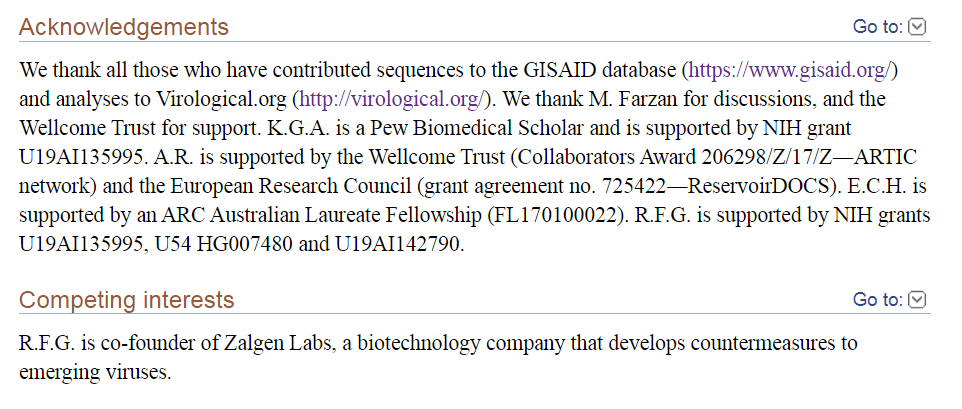
3. K.Andersen didn't mention "competing interests"
Only Garry listed Zalgen Labs, which we will look at later.
In acknowledgements, Michael Farzan, Wellcome Trust, NIH, ERC & ARC are mentioned.
Author affiliations listed as usual.
Note the 328 Citations!
https://t.co/nmOeohM89Q
4. Kristian Andersen (1)
Andersen worked with USAMRIID & Fort Detrick scientists on research, with Robert Garry, Jens Kuhn & Sina Bavari among
5. Kristian Andersen (2)
Works at Scripps Research Institute, which WAS in serious financial trouble, haemorrhaging 20 million $ a year.
But just when the first virus cases were emerging, they received great news.
They issued a press release dated November 27, 2019:
https://t.co/VUYbsKGncx
Kristian G. Andersen
Andrew Rambaut
Ian Lipkin
Edward C. Holmes
Robert F. Garry
2. Thanks to @newboxer007 for forwarding the link to the research by an Australian in Taiwan (not on
3. K.Andersen didn't mention "competing interests"
Only Garry listed Zalgen Labs, which we will look at later.
In acknowledgements, Michael Farzan, Wellcome Trust, NIH, ERC & ARC are mentioned.
Author affiliations listed as usual.
Note the 328 Citations!
https://t.co/nmOeohM89Q
4. Kristian Andersen (1)
Andersen worked with USAMRIID & Fort Detrick scientists on research, with Robert Garry, Jens Kuhn & Sina Bavari among
Our Hans Kristian Andersen working with Jens H. Kuhn, Sina Bavari, Robert F. Garry, Stuart T. Nichol,Gustavo Palacios, Sheli R. Radoshitzky from USAMRIID and Fort Detrick to tell more fairy tales? Full emails listed for queries...https://t.co/kLRoQTxiGD pic.twitter.com/uHNuGraPP2
— Billy Bostickson \U0001f3f4\U0001f441&\U0001f441 \U0001f193 (@BillyBostickson) August 26, 2020
5. Kristian Andersen (2)
Works at Scripps Research Institute, which WAS in serious financial trouble, haemorrhaging 20 million $ a year.
But just when the first virus cases were emerging, they received great news.
They issued a press release dated November 27, 2019:
You May Also Like





This is a pretty valiant attempt to defend the "Feminist Glaciology" article, which says conventional wisdom is wrong, and this is a solid piece of scholarship. I'll beg to differ, because I think Jeffery, here, is confusing scholarship with "saying things that seem right".
The article is, at heart, deeply weird, even essentialist. Here, for example, is the claim that proposing climate engineering is a "man" thing. Also a "man" thing: attempting to get distance from a topic, approaching it in a disinterested fashion.

Also a "man" thing—physical courage. (I guess, not quite: physical courage "co-constitutes" masculinist glaciology along with nationalism and colonialism.)

There's criticism of a New York Times article that talks about glaciology adventures, which makes a similar point.

At the heart of this chunk is the claim that glaciology excludes women because of a narrative of scientific objectivity and physical adventure. This is a strong claim! It's not enough to say, hey, sure, sounds good. Is it true?
Imagine for a moment the most obscurantist, jargon-filled, po-mo article the politically correct academy might produce. Pure SJW nonsense. Got it? Chances are you're imagining something like the infamous "Feminist Glaciology" article from a few years back.https://t.co/NRaWNREBvR pic.twitter.com/qtSFBYY80S
— Jeffrey Sachs (@JeffreyASachs) October 13, 2018
The article is, at heart, deeply weird, even essentialist. Here, for example, is the claim that proposing climate engineering is a "man" thing. Also a "man" thing: attempting to get distance from a topic, approaching it in a disinterested fashion.
Also a "man" thing—physical courage. (I guess, not quite: physical courage "co-constitutes" masculinist glaciology along with nationalism and colonialism.)
There's criticism of a New York Times article that talks about glaciology adventures, which makes a similar point.
At the heart of this chunk is the claim that glaciology excludes women because of a narrative of scientific objectivity and physical adventure. This is a strong claim! It's not enough to say, hey, sure, sounds good. Is it true?