Varanasi, a city that is "Older than history, older than tradition, older even than legend, and looks twice as old as all of them put together", according to Mark Twain.
A city that is among the oldest continuously inhabited cities of the planet.
A city that like several others in the world, gets its name from the rivers which cradled civilisation on their banks.
The old town of Varanasi lies on the banks of the Varuna and Assi rivers.
(Ganga Aarti on the Assi Ghat)
This ancient city is also home to the Lord of the Universe, the God of Gods, Visvanatha!
The Visvanathashtakam, traditionally attributed to Adi Sankara, is dedicated to His glory.
As the name suggests, the Visvanatha Ashtakam has 8 stanzas, with 4 verses in each.
If you'd like to sing/chant the Visvanathashtakam while reading the thread, here's a wonderful rendition by SPB.
https://t.co/VmWIASbWLZ
The Visvanathashtakam (VA) begins in the Kesaadi Paadam style (from the hair down to the feet).
Sankara begins right from the jata, the matted hair of Siva.
And how does he describe it?
Sankara says the matted hair of Siva is beautifully decorated by the waves of Ganga!
Let's look at Ravivarma's painting Descent of Ganga.
Siva's matted hair is open (as we say in Tamil He's the விரிசடைக் கடவுள்)
Sri Rudram of the Krishna Yajur Veda also describes Siva as Kapardin - the one with matted hair.
Ganga descends and beautifully (ramaneeya as Sankara says) decorates his Jata with her waves.
What's a poem without alliteration?!
As the 1st verse begins with Ga of Ganga, Sankara begins the 2nd with Gauri.
As Ganga decorates his jata, Gauri forever adorns his left side (Vama bhaga).
Another Ravi Varma painting.
If the Chola bronze sculptors (yes, I think that's a more appropriate name) achieved one pinnacle in the Nataraja form, they achieved another in the Ardhanarisvara - Siva with Gauri forever on his Vama Bhaga.
Sankara goes on to describe Siva as Narayanapriyam the beloved of Narayana.
A video of a murti from the Thondavada temple, with Siva on one side and Vishnu on the other.
https://t.co/Vz0ys9FQwY This temple briefly appears in the Rajinikanth movie Sri Raghavendra as well!
Sankara then addresses Siva as the one who destroyed the pride of Ananga.
Why is Kama addressed as Ananga? When he disturbs Siva's penance, Siva briefly opens his 3rd eye.
Kama is instantly turned to ash. So, he's the one without a body, Ananga.
The 1st stanza, as with the others, concludes by offering prayers and salutations to the Lord of the city of Varanasi, the Vaaranasi Purapathi, Visvanatha!
2nd stanza:
Even as he describes Siva's various attributes, Sankara feels that Siva has many attributes that are beyond words and speech!
He's Vageesa, who is worshipped by Vishnu and other Suras (Devas).
The next part is beautiful.
Sankara continues on the Ardhanareesvara image, but this time he says that Siva is united with his wife (Kalatravantam) by having Her on His left side.
From Gangaikonda Cholapuram.
Sankara concludes the 2nd stanza by offering his prayers to Visvanatha, the Lord of the town of Varanasi!
The 3rd stanza begins with alliteration with the Bhu sound:
भूताधिपं भुजग भूषण भूषिताङ्गं - Bhuuta-Adhipam Bhujaga-Bhuussanna-Bhuussita-Anggam
Look at how the alliterating Bhu makes you walk smoothly along the verse.
Siva is the Bhuta Adhipati - the Lord of all beings (Bhoot, contrary to what we may believe, is not the word for "ghost". It denotes all that is created)
Sankara continues with the verse to say that Siva has His anga adorned by bhujaga-> snakes (Remember Bhujagasana in Yoga?)
The 3rd verse of this stanza is interesting.
Sankara describes Siva as being clothed in the skin of the tiger.
But why, you wonder? There is a story!
For the story, we need to go to the verdant forest of Darukavana, where a group of sages have become swollen with pride from their Tapasya.
Who's the best hunter, the Nishada, of pride? Siva, of course!
So, Siva enters Darukavana as Bhikshatana.
The wives of the sages worship Him.
The enraged sages attack him with a conjured tiger. A sculpture from Kanchi Kailasanatha temple that captures the moment a sage raises his hand to attack Siva.
The enraged sages attack him with a conjured tiger.
Siva flicks his little finger, to skin the tiger and wears its skin around his waist.
Thus, Sankara calls him Vyaghrajina Ambara Dharam, wearing the tiger skin.
In the same verse, Sankara calls Him, as the one with a Jata and three eyes.
He then goes on to describe what Siva holds in his 4 arms.
Pasa (rope), Ankusa (goad) and Trisoola (trident), and Abhaya mudra.
This is perhaps a depiction earlier to the மான்-மழு (deer and axe) one
To me, it is symbolic of the Panchakritya of Siva.
He binds us with the Pasa of Srishti, the rope which is woven with strands of Tirobhava (concealment), goads us further with Sthithi, uses the Trisoola for Laya and rescues us (Anugraha) with the Abhaya mudra.
Now to the 4th stanza.
Sankara addresses Siva as the one whose kirita (diadem) is adorned with the shining cool one (sheetala).
Who is this shining cool one, you wonder? The moon, of course! Siva is after all, Chandrasekhara!
Sankara contrasts the description of the cool moon on the Kirita with Siva's act of Kamadahana.
He addresses Siva as the one who burnt the five arrows of Kama with His third eye.
From eyes, Sankara moves to the ears and describes Siva as the King of Snakes, wearing other kings of snakes as His earrings.
The 5th stanza begins appropriately with the description of Siva as the one with 5 faces - the 5 aspects of Siva- Sadyojata, Tatpurusha, Isana, Vaama and Aghora.
Interestingly, the word Panchaanana is also a pun.
How?
Panchaanana or Panchamukha also refers to the lion.
In fact, Sankara has composed a full stanza (44) of the Sivananda Lahari, as an elaborate pun on Siva and a lion.
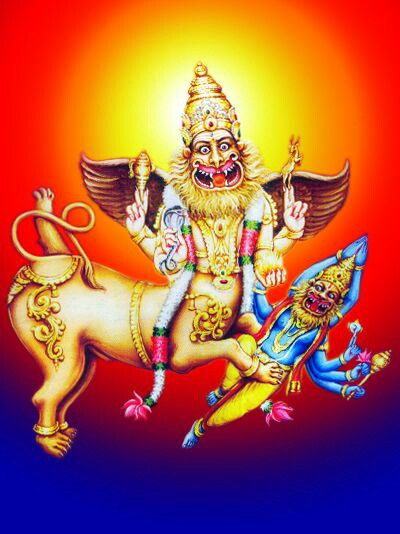
As you may know, the Sarabha form of Siva, when he subdues Narasimha, has the feet of a lion.
Sankara plays on the pun of Siva and the Lion here as well.
He says just as the Lion destroys herds of wild elephants in musth (more on this later), Siva destroys the elephantine pride in us.
Siva did kill an actual elephant demon too.
Wait, what's that?
A vivid sculpture capturing the Gajasura Samhara from Belur. Siva dances surrounded by the elephant skin (notice the head of the elephant at his feet and the legs on the top two sides).
There are various stories on the Gajasura Samhara, but the one from Varaha Purana is a continuation of the Darukavana episode we saw earlier.
So, Siva, like the other Panchaanana, the lion, destroys the pride of elephants.
A bronze depiction of Gajasamhara Moorthy.
There is another pun by Sankara in the Sivananda Lahari, comparing Siva to a bee.
But we'll keep that for another day.
Getting back to Stanza 5.
Siva is also the slayer, in that He is the Lord of birds, Garuda, as he slays the Danavas as Garuda slays the snakes.
Sankara calls Siva as the great forest fire, which consumes sorrow, old age and death itself!
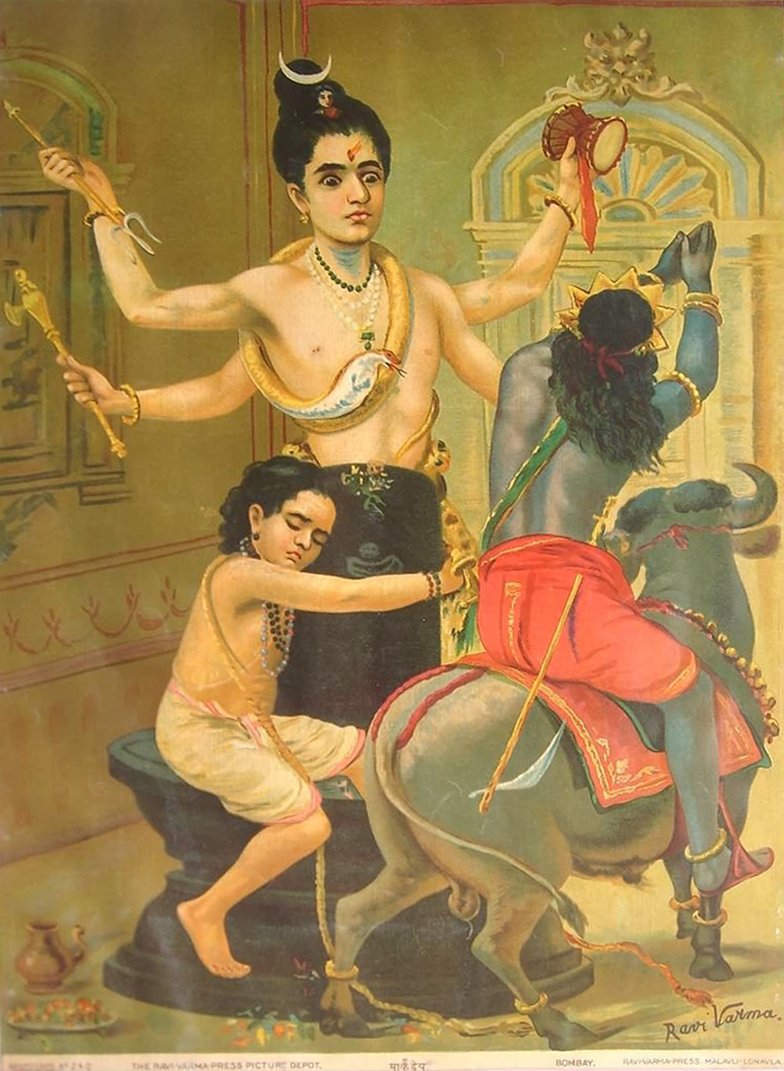
After all, we know from the Markandeya episode, that Siva is Kalantaka!
Sankara concludes the 5th stanza with prayers to Visvanatha, the Lord of the town of Varanasi!
Let's continue the thread with the 6th stanza tomorrow.
Thank you for reading.