Disclaimer
Before we start, these are borrowed ideas.
Borrowed from:
• Gaurav Agarwal
@crazyphoton (Rank 1, CSE2013)
• Anudeep Durishetty
@anudeepd7 (Rank 1, CSE2017)
• Pratyush Pandey (Rank 21, CSE2019)
Even Pratyush and Anudeep mention
@crazyphoton as the OG.
Structure
Your answer needs to have structure.
This makes it easier to read, and ensures that you have covered all parts of the question asked.
Let's look at what makes for good structure.
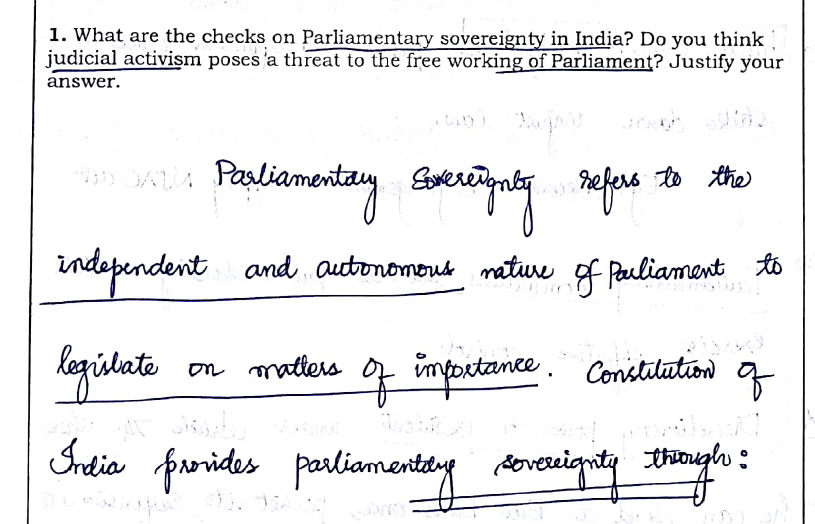
Introduction
Keep it simple.
Choose one word from the question and define it.
Quote facts or relevant articles if possible.
This one line about the topic let's the examiner know you've understood the question.
Example:
Body
Break it into 3 parts:
• Context - what has happened so far
• Main argument
• Counter argument
Give counter arguments (one line works) even when not asked. This adds another angle to your answer.
UPSC is looking for breadth, not depth.
Conclusion
Don't use vague phrases like:
"Thus parliamentary sovereignty must be safeguarded."
"Hence a balance must be stuck between the three powers."
etc
etc
Conclusion II
When possible, quote:
• Committees/Commissions recos
• SC judgements
• Relevant current events
This adds that extra kick to your answers.
Gets you that extra half mark.
P.S. This is what you would need to do as an IAS/IPS.
Why is this structure necessary?
The examiner checking your scripts is not incentivised to look for information in your answer.
Make the information visible.
Make their job easier.
Structure helps them check off, easily, whether you've covered all angles.
Thinking in Frameworks
There will always be questions in Mains that you don't know so well.
What do you do in such cases?
Apply frameworks, like PESTEL or MEDICS (in IR).
Using frameworks will allow you to write even when you don't have specific information.
Content
You would need:
• Notes for quick revision
• A fact sheet
In your content:
• Understand the TRENDS
• Note relevant solutions/way forward
• Supplement with CA
Finally, good language helps, but not necessary.
Content is King!
Presentation
Good presentation is crucial.
Why you ask?
A neat and clean answer makes it easier for the examiner to give you marks.
How do you improve presentation?
• Structure
• Diagrams, maps & flowcharts
• Minimise errors
• Underline & highlight
Feedback
You’ve written the best answer
ACCORDING TO YOU
Feedback helps you work on your blind spots.
Feedback also helps you inculcate best practices for acing CSE Mains.
Take some feedback.
You need to go from
Unconscious incompetence
to conscious incompetence
to conscious competence
to unconscious competence.
Practice will take you there.
Also, I'm forming a Mains Focus Group.
Interested? Fill this form:
https://t.co/V6CXURidjC
For more tweets like this, follow
@abhiwhy And if you liked this thread, please RT the first tweet.
👇👇
https://t.co/j7v5yfpsQC