[ 1 ]
A #thread on Col Tod, the famed historian on Rajput history. His work 'Annals & Antiquities of Rajasthan' is an important reference for beginners to Rajput history.

In this thread, we look at the background of his anti-Maratha atrocity literature.

#Decolonisation #History

[ 2 ]
1799: After a Training course at Royal Military Academy in Woolwich, Tod proceeded to Bengal.

1800, Jan 9: Tod posted as a cadet to the second European Regiment at Kolkata. [ This was the period sometime before the 2nd Anglo-Maratha War (1803-5) ]
[ 3 ]
1803-5: Anglo-Maratha War; British victory

1805: Tod assisted the British Resident (diplomat) at Scindia's court.

In the next ~8-9 years, Tod was constantly on the move through Malwa & Rajputana. He gained immense information on its geography, history & politics.
[ 4 ]
1815: Col Tod submitted a map of Central India to Gov-Gen. Hastings. This map became a crucial strategic tool in the British campaigns against the Marathas that had begun in 1814.
[ 5 ]
In 1814–15, the British continued operations against the Marathas. ̣Tod's map, his personal geographical, historical knowledge, and current condition of the Marathas & associated groups ̣proved immediately invaluable.
[ 6 ]
Before the start of the Third Anglo-Maratha War in 1817, Col Tod started overseeing the British *intelligence department*. He provided plans for possible military campaigns of British vs Marathas.

Intelligence dept. is responsible for wartime propaganda too.

#InfoWars
[ 7 ]
1818: The Third Anglo-Maratha War secured final victory for British over the Maratha forces that had been the major challenge to British supremacy in Northern & Central India.

Doubtlessly, Col Tod played a role here.

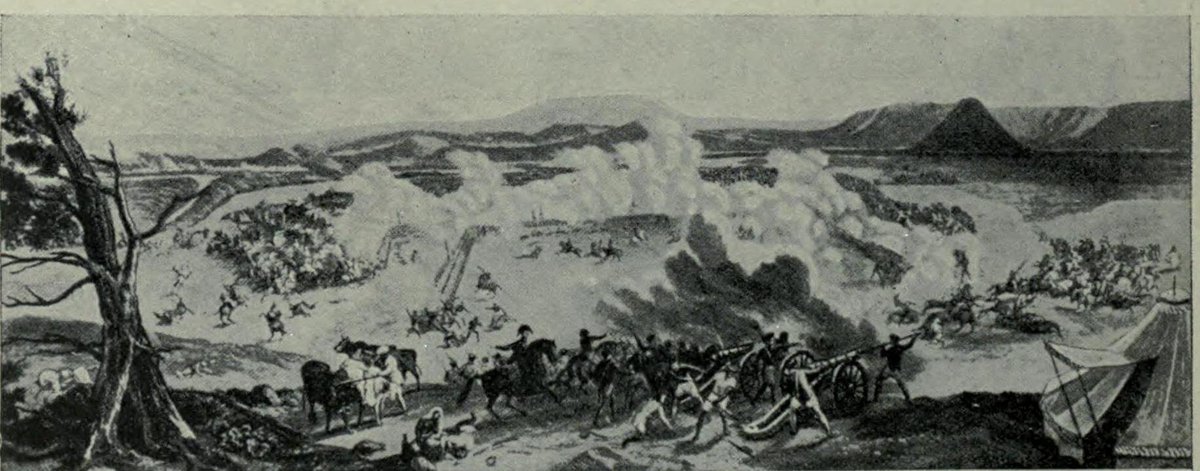
(Battle of Khadki, 1817 👇)
[ 8 ]
Thus, we see a *direct* anti-Maratha role played by Col Tod during his time between the 2nd & 3rd Anglo-Maratha Wars.

*How much should we trust his atrocity literature?*

#Decolonisation #History #India #Decolonise

More from All

You May Also Like

MDZS is laden with buddhist references. As a South Asian person, and history buff, it is so interesting to see how Buddhism, which originated from India, migrated, flourished & changed in the context of China. Here's some research (🙏🏼 @starkjeon for CN insight + citations)

1. LWJ’s sword Bichen ‘is likely an abbreviation for the term 躲避红尘 (duǒ bì hóng chén), which can be translated as such: 躲避: shunning or hiding away from 红尘 (worldly affairs; which is a buddhist teaching.) (
https://t.co/zF65W3roJe) (abbrev. TWX)

2. Sandu (三 毒), Jiang Cheng’s sword, refers to the three poisons (triviṣa) in Buddhism; desire (kāma-taṇhā), delusion (bhava-taṇhā) and hatred (vibhava-taṇhā).

These 3 poisons represent the roots of craving (tanha) and are the cause of Dukkha (suffering, pain) and thus result in rebirth.

Interesting that MXTX used this name for one of the characters who suffers, arguably, the worst of these three emotions.

3. The Qian kun purse “乾坤袋 (qián kūn dài) – can be called “Heaven and Earth” Pouch. In Buddhism, Maitreya (मैत्रेय) owns this to store items. It was believed that there was a mythical space inside the bag that could absorb the world.” (TWX)