https://t.co/sLLhDkBJuD
5 YouTube videos that will make you a better investor:
If that interests you, subscribe here:
https://t.co/lWwcb1JdD1
More from Brian Feroldi (🧠,📈)
1/ My Mission: To Spread Financial Wellness (thread)
Here’s what "financial wellness" means to me
⬇️⬇️⬇️⬇️⬇️⬇️⬇️⬇️⬇️⬇️
2/ Mindset
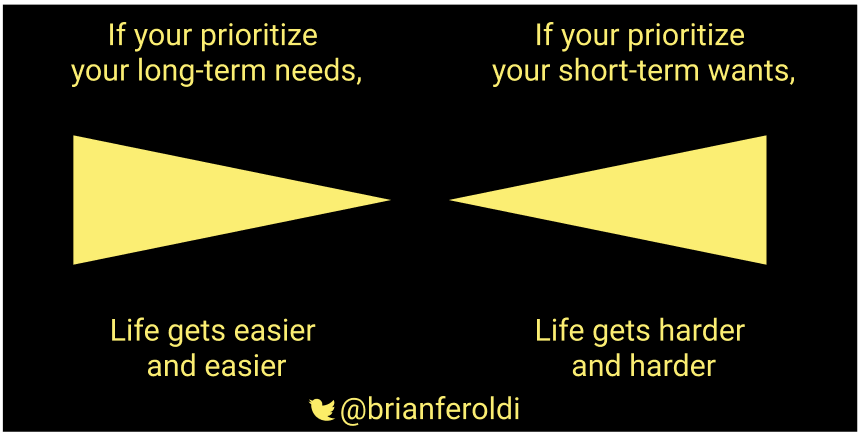
Humans are programmed to think short-term
Evolutionary, thinking short-term makes sense. It helps with survival.
Financial wellness is all about training yourself to develop a long-term mindset
Not easy -- it takes practice
3/ Mindset
If you join the right tribes, you can’t help but improve
My favs:
@AffordAnything
@ChooseFiFI
FinTwit
@MicroCapClub
@themotleyfoolFool
@visualizevalue
Twitter / Podcasts / Blogs / YouTube -- when used correctly -- are amazing
4/ Mindset
Educate yourself - constantly!
Especially about:
1⃣Money
2⃣Relationships
3⃣Health
These 3 categories have an outsized influence on all areas of your life
Books
5/ Career
In the beginning, focus on growing your income
Do more than what is expected
Become a lynchpin
Find a career that you ENJOY (<- important!) that also has high-income potential
Start a side hustle (<- important!)
Build your talent
Here’s what "financial wellness" means to me
⬇️⬇️⬇️⬇️⬇️⬇️⬇️⬇️⬇️⬇️
2/ Mindset
Humans are programmed to think short-term
Evolutionary, thinking short-term makes sense. It helps with survival.
Financial wellness is all about training yourself to develop a long-term mindset
Not easy -- it takes practice
3/ Mindset
If you join the right tribes, you can’t help but improve
My favs:
@AffordAnything
@ChooseFiFI
FinTwit
@MicroCapClub
@themotleyfoolFool
@visualizevalue
Twitter / Podcasts / Blogs / YouTube -- when used correctly -- are amazing
1/ YouTube is an AMAZING resource when used properly (Thread)
— Brian Feroldi (@BrianFeroldi) November 7, 2020
Here are my favorite YouTube channels:
Top 5:
Mark Rober - @MarkRober
Real Engineering
Smarter Every Day - @smartereveryday
Stuff Made Here - @stuffmadehere
Wintegartan - @wintergatan
More \U0001f447\U0001f447\U0001f447\U0001f447\U0001f447
4/ Mindset
Educate yourself - constantly!
Especially about:
1⃣Money
2⃣Relationships
3⃣Health
These 3 categories have an outsized influence on all areas of your life
Books
1/ Book recommendations (thread)
— Brian Feroldi (@BrianFeroldi) November 20, 2020
Start Here:
Choose FI
Richest Man in Babylon
Millionaire Next Door
Rich Dad, Poor Dad
The Wealthy Barber
\u2b07\ufe0f\u2b07\ufe0f\u2b07\ufe0f\u2b07\ufe0f\u2b07\ufe0f
5/ Career
In the beginning, focus on growing your income
Do more than what is expected
Become a lynchpin
Find a career that you ENJOY (<- important!) that also has high-income potential
Start a side hustle (<- important!)
Build your talent
Boosting your salary is a great way to turbo-charge wealth building
— Brian Feroldi (@BrianFeroldi) November 1, 2020
Here's the good news: Your salary is negotiable!@themotleyfool and @ChooseFi have some AMAZING free resources for scoring a big raise:
Use them!
\U0001f447\U0001f447\U0001f447


Last week, I asked my followers to share their favorite Twitter threads
I receive tons of wonderful replies and read through them all
Here are 31 amazing threads that are well worth your time ⬇️
1/ @10kdiver on
2/ @aaronbush100 on 20 semi-controversial investing
3/ @annieduke on category
4/ @awilkinson on losing
I receive tons of wonderful replies and read through them all
Here are 31 amazing threads that are well worth your time ⬇️
1/ @10kdiver on
1/
— 10-K Diver (@10kdiver) April 10, 2021
Get a cup of coffee.
In this thread, I'll walk you through the basics of leverage -- in our personal lives and in the companies we invest in. pic.twitter.com/9MilmwE9f7
2/ @aaronbush100 on 20 semi-controversial investing
20 semi-controversial investing beliefs [THREAD]:
— Aaron Bush (@aaronbush100) May 24, 2020
3/ @annieduke on category
The most dangerous category of poor decisions are ones that remain easily hidden from view because any instance of that type of decision is so easy to rationalize.
— Annie Duke (@AnnieDuke) October 7, 2020
1/12
4/ @awilkinson on losing
This is a story about how I lost $10,000,000 by doing something stupid.
— Andrew Wilkinson (@awilkinson) March 30, 2021
Ten. Million. Dollars.
Literally up in smoke. Money bonfire.
That\u2019s enough to retire with $250,000+ in annual income.
Here\u2019s what happened\u2026
Everyone knows Apple, Amazon, Microsoft...
But how do you find the next $AFRM, $PLTR, or $USPT early?
Here are 9 GREAT resources for finding stock ideas (8 of them are FREE):
1: ETFs
Look through the holdings of high-growth ETFs
Google the ETF symbol and “holdings”
These are worth cracking open:
▪️ $ARKF / $ARKG / $ARKK / $ARKW
▪️ $FFTY
▪️ $HACK
▪️ $IZRL
▪️ $TMFC
2: Fund Managers
Type a fund you respect into @Whalewisdom
You can see all their holding and get emails of any changes
These funds are worth tracking:
▪️AKre Capital
▪️AKO Capital
▪️Dorsey Asset
▪️Fundsmith
▪️Polen Capital
More
3: Newly Public Companies
▪️Direct Listings
▪️IPOs
▪️SPACs
Are a great idea source
Helpful resources:
▪️ https://t.co/jJW01WpJQh
▪️
4. Screeners
@Finviz is great for screening by sector/industry
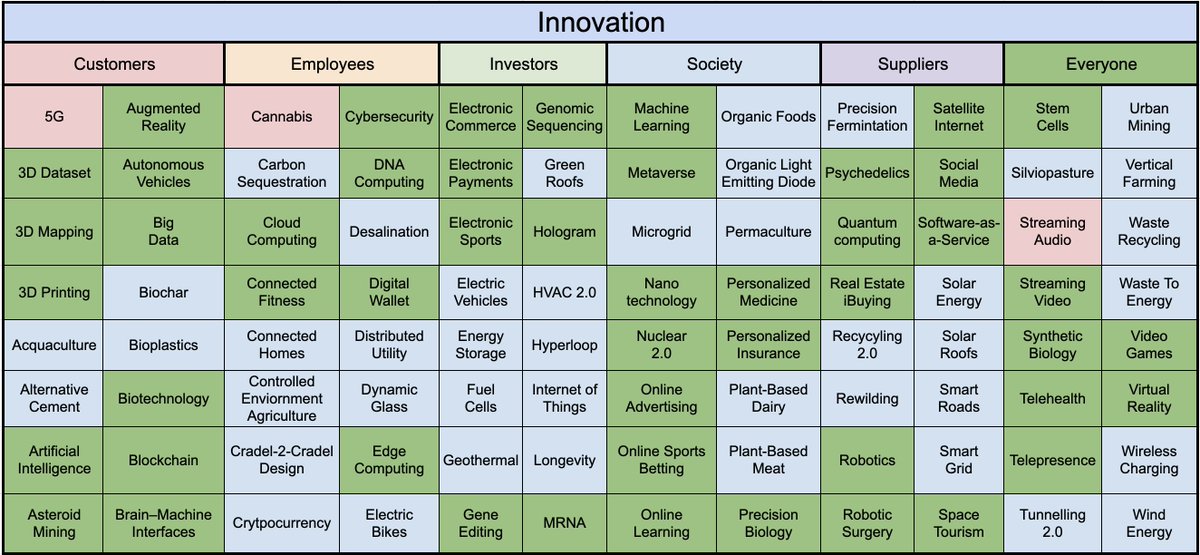
@Stockcard is great for screening by themes (like the mega-trends listed below)
But how do you find the next $AFRM, $PLTR, or $USPT early?
Here are 9 GREAT resources for finding stock ideas (8 of them are FREE):
1: ETFs
Look through the holdings of high-growth ETFs
Google the ETF symbol and “holdings”
These are worth cracking open:
▪️ $ARKF / $ARKG / $ARKK / $ARKW
▪️ $FFTY
▪️ $HACK
▪️ $IZRL
▪️ $TMFC
2: Fund Managers
Type a fund you respect into @Whalewisdom
You can see all their holding and get emails of any changes
These funds are worth tracking:
▪️AKre Capital
▪️AKO Capital
▪️Dorsey Asset
▪️Fundsmith
▪️Polen Capital
More
Here are some of the big investors that track:
— Brian Feroldi (@BrianFeroldi) February 17, 2021
Altarock Partners
AKO Capital
Appaloosa
Akre Capital
Broad Run
Dorsey Asset
Duquense
Ensemble
Fundsmith
Polen Capital
Third Point
Here are their current top 10 holdings (in order) and links to their latest buys/sells \u2b07\ufe0f
3: Newly Public Companies
▪️Direct Listings
▪️IPOs
▪️SPACs
Are a great idea source
Helpful resources:
▪️ https://t.co/jJW01WpJQh
▪️
4. Screeners
@Finviz is great for screening by sector/industry
@Stockcard is great for screening by themes (like the mega-trends listed below)
More from Accounting

Accounting is the language of business.
10 threads that will teach you more about accounting than any accounting degree:
1/ Who: @10kdiver
What: Understand the balance
2/ Who: @SoulFairy3
What: Income statement
3/ Who: @BrianFeroldi
What: Income statement
4/ Who: @AliTheCFO
What: Profit vs cash
10 threads that will teach you more about accounting than any accounting degree:
1/ Who: @10kdiver
What: Understand the balance
1/
— 10-K Diver (@10kdiver) February 5, 2022
Get a cup of coffee.
In this thread, I'll show you how to read and understand a company's Balance Sheet.
As investors, we should be able to judge businesses by looking at their financial statements.
And the Balance Sheet, of course, is 1 of 3 key financial statements: pic.twitter.com/6D0HA0vmEN
2/ Who: @SoulFairy3
What: Income statement
Many new investors are scared of financial statements. I don't blame them. Us accountants complicate the simplest things to keep ourselves employed\U0001f602
— Soul \U0001f4da (@SoulFairy3) December 6, 2021
Let me show you guys the Income Statement first. You honestly just need 3 numbers. Trus bob\U0001f483
Short \U0001f9f5
3/ Who: @BrianFeroldi
What: Income statement
Accounting is the language of business.
— Brian Feroldi (\U0001f9e0,\U0001f4c8) (@BrianFeroldi) July 28, 2021
If you buy stocks, you MUST learn how to read an income statement
Here\u2019s everything you need to know:
4/ Who: @AliTheCFO
What: Profit vs cash
Most founders don\u2019t understand the difference between PROFIT and CASH FLOW
— Ali Ladha (@AliTheCFO) November 2, 2021
Not knowing this difference, could leave your business without cash and push you into bankruptcy
Here are the key differences between PROFIT and CASH FLOW
//A THREAD//