SteveeRogerr Authors Dr Emma Hodcroft
7 days
30 days
All time
Recent
Popular

Lots of tweets about this today!
Let's see what we can see in the focal S:E484 build!
Phylogenetics (what I do - making 'family trees' from virus genetics) can be very informative to see how different variants are spreading, and how cases
There are two variants circulating predominantly in Brazil:
- 20B/S.484K seems to be older & more widespread. It has (among others) a mutation at position 484
- 20J/501Y.V3 is smaller & detected recently. It has mutations at 501 *and* 484.
2/10
https://t.co/Cw5u2kuATa
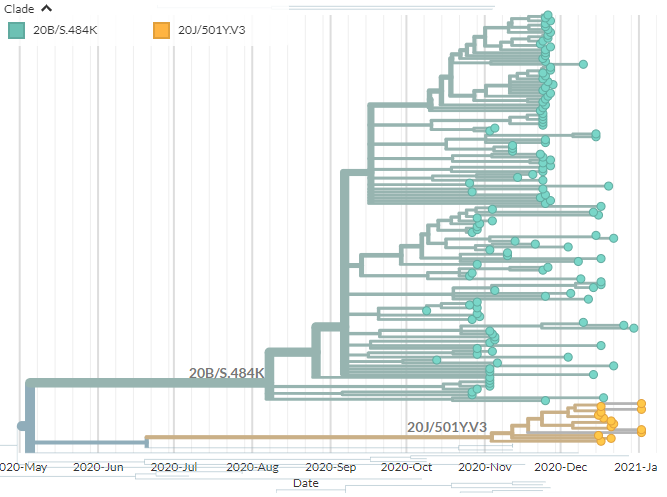
The variant predominantly in the UK (501Y.V1 / B.1.1.7) and the variant predominantly in South Africa (501Y.V2) also both have 501. 501Y.V2 *also* has the 484K mutation.
Why are there concerns about these mutations? You can read more at https://t.co/wVE7ubYBoy!
3/10
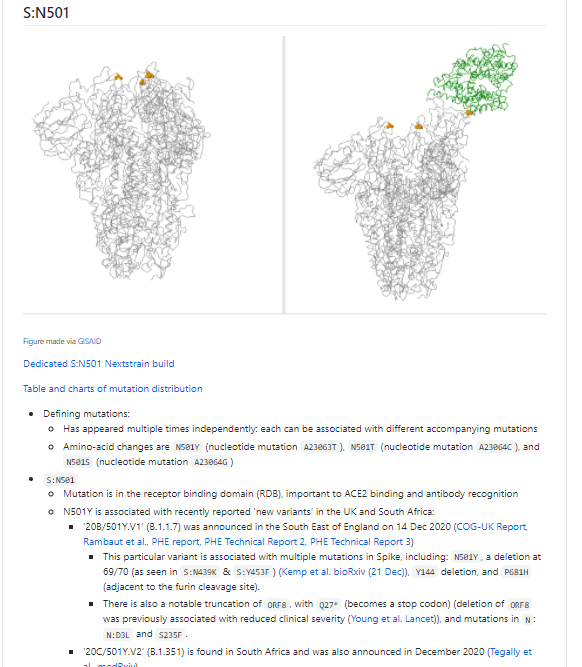
The view below is from an analysis focusing on sequences with a mutation at 484. It shows all the samples in the 2 variants (20B/S.484K & 20J/501Y.V3) & how they're related. More closely related = closer together (very, very roughly).
4/10
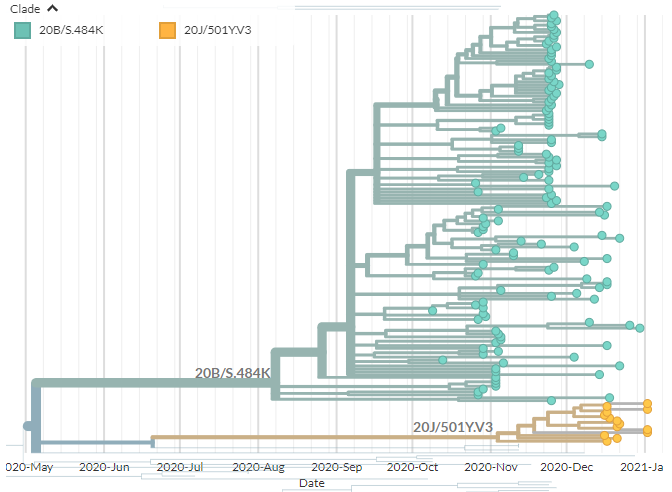
We can colour these samples by region to see where they're from. As we expect - most are in Brazil! A few are in Argentina (also red).
5/10
https://t.co/Cw5u2kuATa
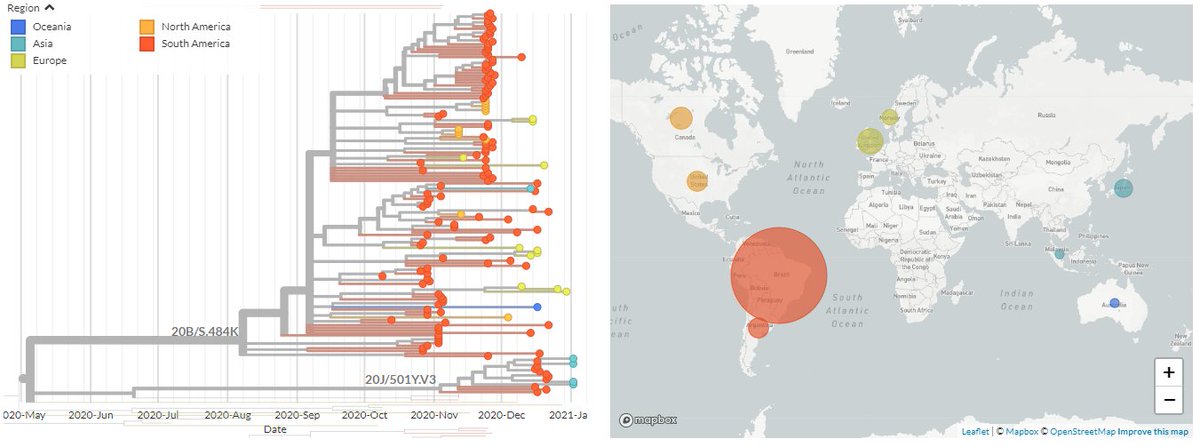
Let's see what we can see in the focal S:E484 build!
Phylogenetics (what I do - making 'family trees' from virus genetics) can be very informative to see how different variants are spreading, and how cases
There are two variants circulating predominantly in Brazil:
- 20B/S.484K seems to be older & more widespread. It has (among others) a mutation at position 484
- 20J/501Y.V3 is smaller & detected recently. It has mutations at 501 *and* 484.
2/10
https://t.co/Cw5u2kuATa
The variant predominantly in the UK (501Y.V1 / B.1.1.7) and the variant predominantly in South Africa (501Y.V2) also both have 501. 501Y.V2 *also* has the 484K mutation.
Why are there concerns about these mutations? You can read more at https://t.co/wVE7ubYBoy!
3/10
The view below is from an analysis focusing on sequences with a mutation at 484. It shows all the samples in the 2 variants (20B/S.484K & 20J/501Y.V3) & how they're related. More closely related = closer together (very, very roughly).
4/10
We can colour these samples by region to see where they're from. As we expect - most are in Brazil! A few are in Argentina (also red).
5/10
https://t.co/Cw5u2kuATa